
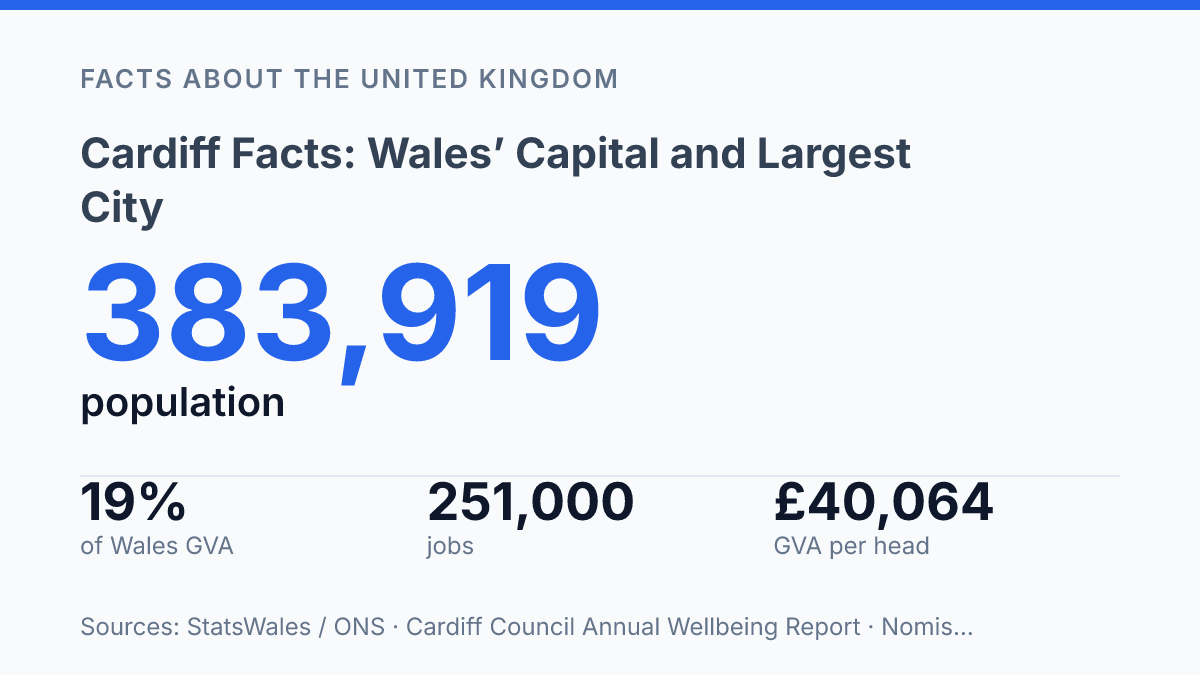
Cardiff holds about 12% of Wales’ people. It generates 19% of the country’s GVA. That mismatch is the story.
In 2024, the capital had 383,919 residents. It supported 251,000 jobs. That’s not how a sleepy medium-sized city behaves.
The surprise sits in the working-age numbers. People aged 16–64 make up 68.0% of the population, well above Wales at 61.1%.
The city also carries a heavier economic profile than its size suggests, with financial and insurance roles taking 7.9% of employee jobs. Across Wales, the figure is 2.7%.
The facts ahead explain the capital as a place of government, labour, housing, and public money. They also clear up what “City and County” means. In my honest opinion, that distinction matters, because scale changes how you read every other statistic.
Why Cardiff matters in Wales
According to StatsWales / ONS, Cardiff had an official mid-2024 population estimate of 383,919, compared with 3,186,581 for Wales. The city accounts for about 12% of the national population. That share matters.
It means the capital is not just a symbolic seat of government. It is a major concentration of people, services, jobs, and public attention inside Wales.
Cardiff is the capital and largest city of Wales, which gives it a weight no other Welsh city can match. National institutions, transport planning, media focus, business decisions, and public spending debates all tend to pass through the capital in some form.
Size alone doesn’t explain that pull. It gives the city the population base to support it.
Here’s the useful contrast: the Welsh capital is still smaller than several major UK cities. Across the United Kingdom, it ranks eleventh by city size.
It doesn’t dominate through sheer scale in the way London, Birmingham, or Manchester do. Its influence comes from role as much as numbers.
That distinction is the key to understanding the city properly. A place can be nationally central without being one of Britain’s largest urban giants. In my view, that’s what makes the capital more important than a simple population ranking suggests.
For Wales, the city functions as both a demographic anchor and a national reference point. When people talk about Welsh government, major employment centres, higher-level services, or the country’s urban growth, they usually have the capital in mind. But the numbers keep the picture honest: this is a powerful Welsh city, not a UK mega-city.
What the City and County of Cardiff means
The phrase “City and County” sounds like civic ornament. It is the legal container that decides where the council’s powers start and stop.
Cardiff forms a principal area officially known as the City and County of Cardiff. That wording appears in the UK government’s toponymic listing as “Cardiff, City and County of” and in Welsh as “Caerdydd, Dinas a Sir,” according to GOV.UK Toponymic Guidelines.
A principal area is the basic unit of local government in Wales. It is the area served by a single local authority, with responsibility for everyday public services such as planning, social care, education, waste collection, local roads, housing functions, and council tax administration.
Wales has 22 unitary authorities, created in April 1996. This city-county status places the local authority alongside counties and county boroughs in that same system.
The boundary matters. When official figures describe the city, they are not just pointing to the dense urban core or the place visitors recognise from maps and train signs.
They are using the administrative area governed by the council. That means the official city is counted through this local-government unit, not through a looser idea of the built-up area.
This creates a useful tension. The name can feel ceremonial. It carries practical force.
It affects service planning, land-use decisions, budgets, and how public statistics are reported. Cardiff Council says the area covers about 140 square kilometres and contains around 167,000 homes, which shows why the label is more than branding. In my honest opinion, this is the detail that stops people misreading the city’s size, role, and responsibilities.
How Cardiff compares with other UK cities
A city can sit outside the UK’s top ten by population and still run the public life of a nation. The Welsh capital’s official mid-2024 estimate of 383,919, according to StatsWales and ONS data, puts it behind a clear group of larger UK cities rather than inside the heavyweight tier.
The comparison is useful because the gap is real. London sits in a class of its own, and cities such as Birmingham, Leeds, Glasgow, Sheffield, Manchester, Bradford, Edinburgh, Liverpool, and Bristol all carry larger populations. That doesn’t make the Welsh capital small. It makes it a mid-ranking UK city with a far bigger constitutional role than its headcount suggests.
This is where capital status can mislead you. People hear “capital” and assume a place must rank near the very top by size. Here, it doesn’t.
The city ranks eleventh in the United Kingdom by population. It still carries the political, civic, and symbolic weight attached to a national capital.
That mismatch matters. A larger English city may have more residents. It doesn’t perform the same national function for England as this city performs for Wales. In my humble opinion, that gap is the key to understanding its importance: size explains part of the story, but status explains why the city carries more weight than a simple ranking suggests.
So the best comparison isn’t “big or small.” It’s scale versus responsibility. The Welsh capital is not one of the UK’s biggest urban authorities.
It operates with national-capital expectations. That pressure shapes how people read its population figure, its public profile, and its place in the UK hierarchy.
Why the city’s scale matters for readers
A city can be a national capital, a formal county area, and still sit outside the UK’s biggest urban tier. That mismatch is exactly why the numbers matter.
Set the three facts side by side: the Welsh capital role, 383,919 residents in the 2024 StatsWales/ONS estimate, and formal City and County status. None tells the whole story alone. Together, they show why a plain population list can flatten civic reality.
Official boundaries matter when you compare places. A city’s administrative frame affects local services, budgets, elections, and published statistics. But a ranking table strips that away and makes unlike places look cleaner than they are.
The same population figure carries different weight in Wales than it does in a UK-wide table. Inside Wales, it marks the country’s main urban reference point. Across the UK, it sits in a middle tier where function and rank start to pull apart.
Researchers should care about that split. If you’re comparing Welsh urban centres, the Welsh capital gives you the top-end marker for scale within the country. If you’re comparing UK cities, it shows how capital status, legal identity, and population size don’t always line up neatly.
The economic data makes the point sharper. Nomis/ONS recorded 251,000 jobs in the city in 2024, with a jobs density of 0.96 per resident aged 16–64. That means the place behaves less like a residential district and more like a work hub for a wider area.
In my view, the mistake is reading the population as if it explains the city by itself. The useful comparison comes from holding all three measures at once: what the place is politically, what it is administratively, and how large it is in the UK hierarchy.
Why the numbers point to pressure, not just status
The smarter way to read the capital is to treat every number as a pressure test. A population figure tells you one thing. A jobs total, a housing count, or a council budget tells you something sharper.
The formal label matters here. Wales’ 22 unitary authorities arrived in April 1996. The official Welsh form Caerdydd, Dinas a Sir points to the same idea: this is not just a city name on a map.
It is a service machine, a labour market. A funding problem in one boundary.
That’s why a £849.284 million net revenue budget can sit beside a 6% Council Tax rise. Growth brings weight.
It also sends the bill somewhere. In my humble opinion, the next honest question isn’t whether the capital is big. It’s whether Wales has built the right tools for a city carrying this much of the load.
Frequently Asked Questions
Q: Is Cardiff the capital of Wales?
A: Yes. Cardiff is the capital and largest city of Wales. That role gives it outsized political weight. It’s not just a label. Government, culture, and transport all point there.
Q: How many people live in Cardiff?
A: Cardiff had a population of 383,919 in 2024. That makes it a major UK city, not just a regional centre. In my view, that size matters because it gives the city real momentum without feeling overwhelming.
Q: What is Cardiff officially called as an area?
A: The city forms a principal area officially known as the City and County of Cardiff. That title matters because it covers both the urban core and the wider local authority area. People usually just say Cardiff. The formal name is longer.
Q: Where does Cardiff rank among UK cities by size?
A: Cardiff is the eleventh largest city in the United Kingdom. That puts it above a lot of places people assume are bigger. The rank surprises some visitors. The numbers are clear.
Q: Why is Cardiff important to Wales?
A: Cardiff matters because it’s both the capital and the largest city. It carries political and economic weight at the same time. That combination is rare. You get a city that feels local. It still shapes the whole country.