
The Giant’s Causeway didn’t simply “cool into hexagons”. Its basalt cracked when the rock had already dropped to about 840–890°C, a narrow failure window that makes the postcard version feel too neat.
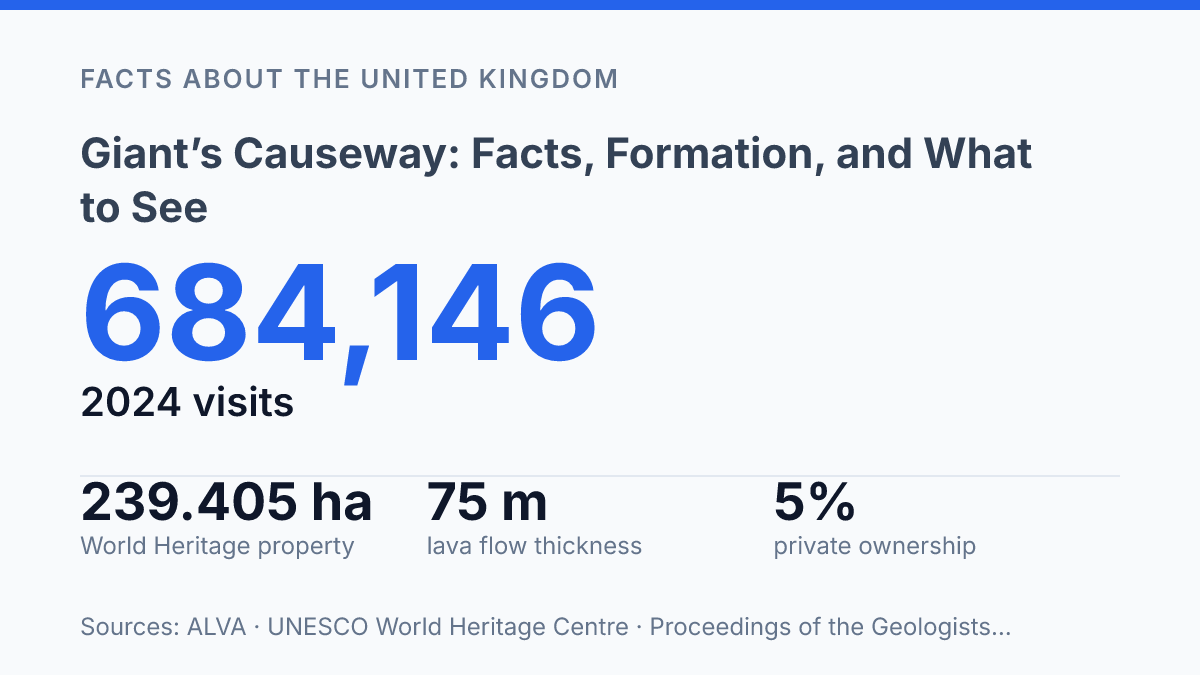
That detail changes how you read the coast. The columns are not a frozen trick. They’re evidence of heat, stress, sinking ground, and lava that pooled as thick as 75 m beneath Aird Snout.
Recognised by UNESCO in 1986, the 239.405-hectare property sits inside a wider coast of cliffs, bays, paths, and arguments about what this rock records.
Expect geology with teeth, not a tidy origin story. You’ll see why this small stretch beats much longer coasts for drama, why myth still matters, and what first-time visitors should notice before the crowds push them along. In my honest opinion, the best part isn’t the legend. It’s how precise the stone is.
How the basalt columns formed
The columns look too precise for a lava flow, yet their geometry began as a failure pattern in cooling stone. At the Giant’s Causeway, that story starts about 60 million years ago, when intense fissure volcanism split the ground in what is now Northern Ireland. Lava poured out across the surface rather than bursting from one neat cone.
As the lava lost heat, it shrank. That shrinkage pulled the rock apart, and cracks spread through it in repeated patterns. Research in Nature Communications shows that columnar jointing occurs when cooling basalt fails at about 840–890°C, below a basalt solidus of about 980°C. The process is more exact than “hot rock turned into hexagons.”
The site contains around 40,000 interlocking basalt columns. Most are hexagonal, but not all.
Some have fewer sides, some have more. That variation matters: nature found an efficient cracking pattern, not a perfect design template.
In my view, the neat hexagonal shapes look engineered, but they’re the messy result of cooling rock. That’s the best part of the science here.
The pattern feels planned. It came from stress, contraction, and fracture spreading through a thick lava flow.
The famous Finn McCool legend gives the stones a very different origin story. In that version, a giant builds a causeway across the sea toward Scotland.
The myth is more memorable than the physics. The real formation story has its own punch: fire, cooling, cracking, and time made a structure that still looks almost impossible.
Why this stretch of coast stands out
From above, the columns can look like a half-built pier abandoned to the Atlantic, but every edge is natural. That tension is the first shock of the place. Your eye reads design before your brain accepts geology.
The site sits in County Antrim, Northern Ireland, on a hard Atlantic-facing coast where rock, tide, and exposure do the displaying. The columns don’t just sit under a cliff. They spread outward in terraces, ledges, and uneven steps that let people walk among them rather than only view them from a distance.
What makes this stretch stand out is the way the shapes repeat without becoming tidy. Some columns rise like posts. Others break off into low platforms.
The shore feels like a staircase sinking into the sea. It looks controlled, almost paved. The uneven heights keep it from feeling manufactured.
Scale matters here. A 2021 study in Proceedings of the Geologists’ Association reported that the main lava flow is just over 20 metres thick along much of the coast, but reaches about 75 metres beneath Aird Snout at the Causeway. That extra depth helps explain why this specific section has such a strong visual punch compared with nearby rock faces.
Fingal’s Cave in Scotland has famous basalt columns too, and its sea-cave setting is dramatic. The Giant’s Causeway is better known because it gives you the pattern at ground level. You can stand on the tops, trace the edges with your eyes, and watch the formation run into breaking water.
That accessibility is also the tradeoff. The place invites touch, movement, and close inspection.
It isn’t a playground built for visitors. In my honest opinion, its power comes from that uncomfortable fact: it feels designed for human feet. It wasn’t designed at all.
Myth, UNESCO status, and why people visit
A giant losing a fight by pretending to be a baby is the detail that makes the stones stick in memory. In the Irish legend, Finn McCool builds a stone path across the sea to face the Scottish giant Benandonner. When Finn sees his rival is far larger, his wife Oonagh disguises him as an infant, and Benandonner runs home in fear of how huge the “baby’s” father must be.
That story gives the place a hold that bare facts alone don’t always achieve. It turns rock into character, coastline into plot. A natural site into a shared cultural reference.
But it shouldn’t be treated as history. In my humble opinion, the myth keeps the place memorable. The real geology is stronger than the story.
International recognition gives the site a different kind of weight. UNESCO inscribed Giant’s Causeway as a World Heritage Site in 1986, according to the UNESCO World Heritage Centre. The listing matters because it marks the area as globally significant, not just locally famous, and ties its protection to natural criteria for beauty and Earth history.
The protected property covers 239.405 hectares, with a minor boundary change recorded in 2016 by UNESCO. That kind of status brings prestige. It also brings pressure.
More visitors mean more wear, more management. A constant need to balance access with conservation.
The pull is obvious in the numbers. The site draws hundreds of thousands of visitors each year. The Association of Leading Visitor Attractions recorded 684,146 visits in 2024.
That made it Northern Ireland’s second-highest listed attraction after Titanic Belfast. People come for the photos, the folklore, the coastal drama. The feeling that the place belongs to more than one kind of story.
What to look for on a first visit
The Wishing Chair is easy to miss if you arrive looking only for the biggest stones. It sits among the lower columns as a natural stone seat, polished smooth by generations of visitors. Find it, sit briefly if access is safe, then move on so the next person can see it too.
Start with the Grand Causeway. This is the broad stone approach most people picture: dark columns dropping in steps toward the sea, with flat tops that make the place feel almost built by hand. In my view, this is where the site makes its strongest first impression, not because it’s the most hidden feature, but because it lets you read the shape of the shore with your feet.
Look up as well as down. The Organ rises as a set of tall, regular columns on the cliff face. It rewards slower looking more than quick photos.
From the right angle, the vertical stones look arranged with a precision that feels architectural. The rough edges keep pulling the scene back into nature.
Conditions change what you can actually see. Low tide can reveal more of the lower stones, but wet basalt turns slick fast. Wind, spray, glare, and cloud can alter the whole experience within minutes.
The “best” view isn’t fixed. Wear shoes with grip and treat every shiny surface as suspect.
The place feels wild, but access is tightly managed… and that control is what keeps it intact. National Trust staff manage visitor movement through marked routes, signs, and conservation work. Those paths aren’t there to spoil the mood. They keep pressure off fragile edges, reduce erosion, and stop crowds from treating the columns like an open playground.
Small actions leave expensive marks. In 2025, the National Trust said removing coins wedged into the stones was expected to cost more than £30,000, and corroding coins can crack and stain the basalt. That detail changes how you should look at the site: not as a souvenir machine, but as a place where restraint is part of the visit.
What the stones ask of every visitor
Leave nothing in the cracks, not even a coin.
The National Trust warned in 2025 that removing wedged coins could cost more than £30,000. The damage isn’t cosmetic.
Corroding metal can swell to three times its thickness. Basalt loses that fight.
That changes the way you visit. The site can handle Atlantic weather and hundreds of thousands of visitors, but careless souvenirs leave scars that staff have to repair by hand. In my humble opinion, a first visit should feel less like collecting proof and more like earning the right to stand there.
Take photos. Walk slowly.
Keep your hands out of the joints. The oldest lesson on that coast is also the plainest one: stone survives pressure, but not endless small acts of neglect.
Frequently Asked Questions
Q: How was Giant’s Causeway formed?
A: It formed after an intense volcanic fissure eruption about 60 million years ago. Lava cooled fast, cracked, and broke into the tight column shapes you see today. The geology is the real story here… and it’s more striking than the legend.
Q: Why are the rocks at Giant’s Causeway hexagonal?
A: The hexagonal shape comes from cooling basalt contracting at an even rate. That stress makes the rock split into neat columns instead of random chunks. Nature doesn’t always aim for perfect geometry. This time it did.
Q: How many basalt columns are there at Giant’s Causeway?
A: There are over 40,000 interlocking basalt columns. That number is what makes the site feel so dense and ordered at the same time. In my view, it’s one of the few places where the rock pattern alone is worth the trip.
Q: Where is Giant’s Causeway located?
A: It’s in County Antrim, Northern Ireland, right on the coast. The setting matters because the columns run straight into the sea, which makes the whole formation look even sharper. You get geology and coastline in one view.
Q: What should I not miss when visiting Giant’s Causeway?
A: Don’t just stop at the main stone steps. Walk the edges, look back from different angles, and notice how the columns shift with the light… that’s where the site feels strongest. The famous legend is fun. The rock itself steals the show.