
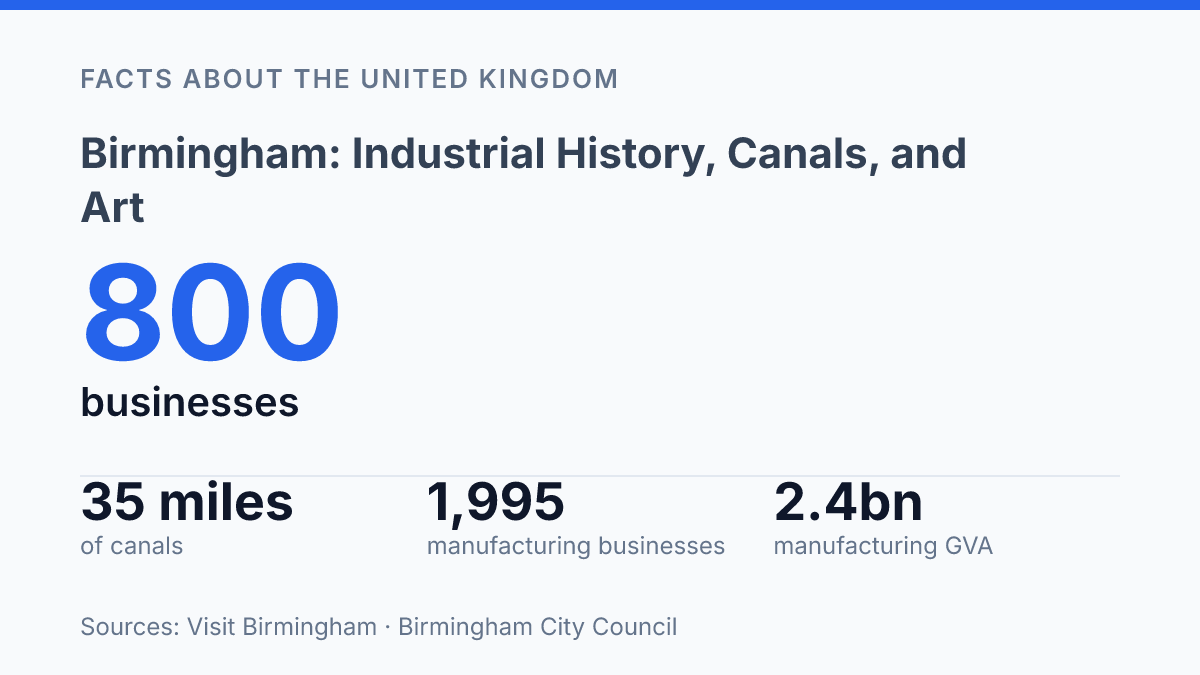
Birmingham still makes £2.4bn a year from manufacturing, even though its biggest money now comes from services. In 2023, that factory output still counted for 7% of city GVA.
That’s not nostalgia. It’s a working inheritance.
The surprise is how visible that inheritance remains. The Jewellery Quarter still produces about 40% of Britain’s jewellery. The city centre now speaks in canalside offices, gallery rooms, student flats, and financial services.
Old Brum didn’t vanish. It got repurposed.
This guide follows the metal, water, and art that explain the city better than any skyline photo. You’ll see how workshops made a manufacturing giant, why 35 miles of canals still steer movement, and how museum collections turn civic pride into something more complicated. In my honest opinion, the best version of the city is the one that refuses to choose between industry and reinvention.
How Birmingham grew into a manufacturing giant
The city’s industrial power came less from one giant factory than from thousands of workshops turning metal into tools, jewellery, machine parts, and precision goods. That pattern mattered. It made production flexible, skilled, and hard to copy.
During the 18th century Industrial Revolution, this West Midlands hub grew by linking craft skill with engineering ambition. Metalworking sat at the core. Makers worked in brass, steel, iron, and precious metals, then fed parts and techniques into a wider manufacturing belt across the region.
Soho House gives that story a human address. It was the home of Matthew Boulton, whose nearby Soho works helped push factory organisation, steam power, and engineered production into a new phase.
The site doesn’t just preserve a grand house. It points to the moment when invention, finance, science, and manufacture started sharing the same room.
The Jewellery Quarter tells a different version of the same rise. Its streets still carry the scale of small-unit production: workshops, assay offices, narrow plots, and specialist suppliers packed into a district built around skill rather than spectacle.
That’s why it feels distinct from a museum piece. The area still reads like a working industrial map, even as bars, studios, apartments, and guided walks reshape its purpose.
The contrast is sharp. The city is still tagged as a place of heavy industry, but many of its best-known industrial sites now sell culture, memory, and heritage tourism rather than mass production. In my view, that reversal makes the industrial story more interesting, not less.
The old identity hasn’t vanished from the economy either. Manufacturing generated £2.4bn in GVA in 2023, up £86m or 3.7%, and made up 7% of city GVA, according to Birmingham City Council.
So the past isn’t just branding. It still leaves a measurable mark, even in a city now read through offices, universities, culture, and services.
The canal network that still shapes the city centre
From Sherborne Wharf, the canals still steer people through the centre more efficiently than some streets do. Boats no longer set the city’s working rhythm. The water routes still decide where people pause, walk, eat, and meet. In my honest opinion, this is the best place to understand the canals as infrastructure, not decoration.
The first main canal reached the town in 1769. That date still matters. It explains why the waterways don’t sit politely beside the centre.
They cut through it. From the wharf, routes radiate out toward former industrial districts, linking areas that once depended on moving coal, metal, glass, and finished goods by water.
There’s a sharp reversal here. These channels were built for freight and factory output. They now attract people who want coffee, drinks, dinner, or a slower walk between meetings. The same towpaths that supported heavy movement now support leisure.
That shift sounds neat. It isn’t just a makeover. The canals work because their original logic remains visible.
The city has 35 miles of canals, according to the city council. The wider regional network runs to more than 100 miles today.
The Canal & River Trust’s local Ring route stretches 45 miles and passes through 49 locks, which turns a city-centre stroll into part of a much larger water system. That scale is easy to miss when you’re sitting beside a bar with a narrowboat sliding past.
Canal-side cafés and bars succeed because they borrow the canals’ old strengths: direct routes, sheltered edges. A sense of movement. Places around the wharf, Gas Street Basin, and Brindleyplace don’t treat the water as a postcard view.
They use it as a spine. You can feel the city centre bending around it, still.
Inside Birmingham Museum and Art Gallery
The sharpest twist inside Birmingham Museum and Art Gallery in the city centre is that its strongest draw belongs not to machines, but to dreamlike medievalism, stained glass, and red-haired figures charged with symbolism.
That contrast matters. A city known for metal, engines, and workshop skill also holds one of the strongest Pre-Raphaelite collections in the country. The museum opened in 1885, and its art collection gives the city a cultural weight that doesn’t fit the lazy factory-town stereotype.
The star here is Edward Burne-Jones, who was born locally and became one of the movement’s defining artists. His work gives the collection a direct civic link, not just a curatorial one. Dante Gabriel Rossetti adds another layer, with images that push beauty into something stranger and more psychological.
Scale helps explain why the museum stands apart among regional museums in England. Birmingham Museums says the refurbished Pre-Raphaelite galleries feature over 60 paintings, sculptures, and stained-glass panels. That’s enough to show the movement as a full artistic world, not a token room with a few famous names.
The collection doesn’t matter only because it is large. It matters because it complicates the city’s story. In my humble opinion, this is where the overview of the city becomes more honest: industry paid for and shaped public culture, but public culture also refused to be merely practical.
You don’t need a full room-by-room guide to see the point. The museum’s best-known holdings show a city that made things and imagined things with equal seriousness. That tension is exactly why the collection belongs in any short account of the city.
What Birmingham tells you about modern England
A city that produces £38.9bn in total economic output now sells culture and canal-side time as confidently as it once sold things you could hold in your hand, according to Growth in Brum and the city council. That figure matters. It shows a place that has moved far beyond its factory image without leaving it behind.
As a major city in England’s West Midlands, it also tells a wider national story. Modern England isn’t only shaped by capitals, cathedrals, and postcard towns. It’s shaped by large regional centres where old infrastructure gets reused, civic art gains fresh meaning, and daily life carries on between office blocks, towpaths, shops, cafés, galleries, and train platforms.
The split is the point. The old identity came from output: skill, metal, workshops, movement, export.
The current centre sells experience instead. You walk beside canals that no longer need cargo, then step into cultural spaces that ask the city to be read as creative, not just productive.
But that shift isn’t tidy. Regeneration can make industrial memory feel polished, even softened.
A former working city can be packaged too neatly for visitors and investors. In my view, the most honest reading of the centre is not that it has reinvented itself. That it keeps arguing with its own past.
Census data from 2021 recorded the city as 51.4% Black, Asian and Minority Ethnic, up from 42.1% in 2011, according to Birmingham City Observatory. That change adds another layer to the story.
The city’s modern character is not just post-industrial. It’s younger, more mixed, and more reflective of where England is heading.
So the centre matters because it refuses one simple label. It is heritage, commerce, culture, and ordinary urban life pressed together in a tight space.
The result is not a museum piece. It’s a working example of how an industrial city carries memory while trying to make itself legible for the present.
What Brum reveals after the factory smoke clears
The next move isn’t to freeze Birmingham in soot and red brick. It is to read the old infrastructure as a live map for what comes next.
By 2021, the city was 51.4% Black, Asian and Minority Ethnic. That shift changes how museums tell stories, how canal edges get used, and who gets to feel ownership of the centre. The Canal & River Trust can mark a 45-mile ring on paper, but people decide whether those miles feel public or private.
In my humble opinion, the smartest way to visit is to look for friction. Old workshops beside finance offices. Pre-Raphaelite rooms near new migrant food streets.
Memory beside money. A city this layered doesn’t ask you to admire the past. It asks what you’re willing to build from it.
Frequently Asked Questions
Q: What is Birmingham best known for historically?
A: Birmingham built its reputation as a manufacturing powerhouse during the 18th century. That industrial past still shows in the city’s landmarks. That matters more than a neat museum label. In my view, the history here feels lived-in, not polished.
Q: Are the canals in Birmingham worth visiting?
A: Yes. Birmingham’s canal network is one of the city’s best surprises, and many of the routes radiate from Sherborne Wharf. You’ll find cafes and bars along the water now. The old industrial layout is still easy to read.
Q: What can you see at Birmingham Museum and Art Gallery?
A: The Birmingham Museum and Art Gallery is known for its pre-Raphaelite masterpieces. That makes it a strong stop if you want art with real depth, not just a quick gallery visit. The collection gives the city a different side.
Q: How does Birmingham connect its industrial past with modern life?
A: It does it in a very visible way. Industrial-era landmarks sit near canal-side spots and cultural venues. You get history and daily city life in the same walk. That mix is the point.
Q: Is Birmingham a good city for a short cultural trip?
A: Yes, if you want variety without wasting time. You can cover industrial history, canal scenery, and major art in one trip. The city centre makes that easy. Birmingham works best when you move between those layers fast.