
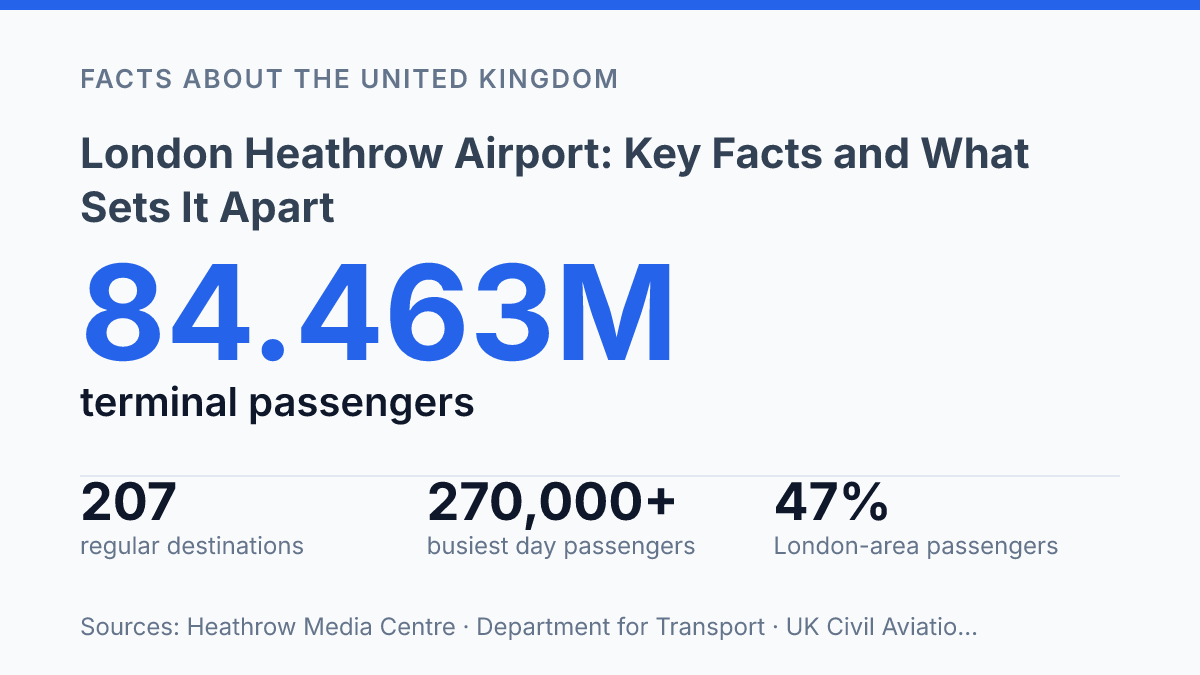
London Heathrow Airport carried 84.463 million terminal passengers in 2025. It began with just 63,000 in its first operational year after 1 January 1946.
That jump is not airport trivia. It explains why Heathrow still bends the UK’s long-haul market around itself.
The surprise is not scale alone. Gatwick, Stansted, Luton, City, and Southend all serve London, but none has the same pull on intercontinental routes, business travel, or national planning debates.
This guide looks at how a postwar airfield became the country’s main gateway, why its name changed from London Airport in 1966, and how ownership now sits with global infrastructure and sovereign-wealth investors. In my honest opinion, the real story is not that Heathrow is big. It’s that London’s airport system still depends on one place more than most passengers realise.
How Heathrow became London’s main air gateway
Heathrow’s rise began with a tiny route map, not a grand terminal: just 6 postwar passenger routes had to prove London could still reach the world by air. That small start matters.
The airport didn’t inherit dominance fully formed. It earned it by absorbing the pressure of a capital that wanted fast links beyond Europe.
Commercial operations began on 31 May 1946, after wartime use gave way to civilian flying. According to Heathrow, the site was handed over as London’s new civil airport on 1 January 1946, handled 63,000 passengers in its first operational year, and reached 796,000 by 1951. That jump shows how quickly a modest airfield became a national asset.
One of the first carriers there was British South American Airways, a clue to Heathrow’s early purpose. This was never only about short hops to nearby cities.
London needed routes that reached across oceans. The airport’s western edge gave operators the room and orientation to think bigger.
Jet aircraft changed the scale of the place. Propeller-era services could make Heathrow useful, but jets made it unavoidable. They demanded longer runways, faster turnarounds, larger terminals.
A different kind of passenger flow. The airport had to grow before the city outgrew it.
That pressure created the pattern still visible at London Heathrow Airport today. In my view, the most revealing part of its story is the contrast: it started as a practical postwar fix. It quickly became the airport expected to carry London’s global ambitions. That’s a heavy role for any airfield.
Heathrow took it on early. The rest of UK air travel adjusted around it.
Why this airport sits at the center of UK long-haul travel
A single airport can tilt a country’s route map, and Heathrow does it with only two main strips of concrete.
The current official name, Heathrow Airport, understates its role. It is London’s primary international airport and the UK’s main long-haul platform.
Airlines don’t just serve it for local demand. They use it to connect Britain with the routes that carry business travel, cargo, tourism, and diplomatic traffic.
Scale explains the pull. Heathrow had a 60 million-plus annual passenger base in a normal pre-pandemic year, which gave airlines a deep pool of demand before global travel was disrupted.
The rebound has been even starker. Heathrow’s Media Centre reported 84.463 million terminal passengers in 2025, a figure that puts it back in the top tier of global hubs.
Route strength matters as much as raw volume. The Department for Transport’s 2026 UK Aviation Forecast counted 207 regular destinations from Heathrow in 2025, including 198 international points. That breadth gives passengers options that smaller airports can’t match. In my honest opinion, this is why Heathrow matters more than its footprint suggests: it concentrates choice.
Yet the whole machine rests on 2 main runways. That’s the mismatch at the heart of Heathrow.
It handles traffic levels that would usually be spread across a larger runway system, so small disruptions can ripple fast. Bad weather, late inbound aircraft, air traffic restrictions, and tight scheduling all have less room to breathe.
The long-haul focus sharpens that pressure. UK Civil Aviation Authority CAP3013 data shows that 37% of Heathrow’s daytime movements in 2025 were long-haul flights over 3,500 km. At night, the share rose sharply.
That pattern reflects global time zones and airline economics. It also feeds noise concerns and planning fights.
Heathrow is huge. It isn’t spacious. That tension shapes its value and its problems at the same time. Passengers get unmatched international reach from the UK.
Airlines get a prized network position. The country gets global access. Everyone also inherits the delays, slot scarcity, and expansion arguments that come with squeezing a world-scale hub onto a runway pair.
Ownership, operations, and the name change from London Airport
The oddest thing about Heathrow’s identity is that its familiar name is newer than the jet age that made it famous. The airport was still called London Airport until 1966, when it took the Heathrow name from the local area. That change mattered.
A generic national label became a place-based brand. The name stuck so completely that the old one now sounds almost fictional.
Control sits with Heathrow Airport Holdings, the company that owns and operates the airport. According to Heathrow’s 2026 ownership information, its parent structure is led by large infrastructure and sovereign-wealth investors, including Ardian, Qatar Investment Authority, Saudi Arabia’s Public Investment Fund, GIC, Australian Retirement Trust, and China Investment Corporation.
That mix tells you something useful: Heathrow isn’t run like a town hall service. It’s a major asset with investors watching returns, risk, debt, regulation, and expansion plans.
The corporate name has its own twist. The ownership label changed after BAA’s competition-inquiry-driven restructuring, with 2006 marking the shift to Heathrow Airport Holdings. The detail can feel remote if you’re standing in a security queue, but corporate control shapes the experience you actually notice.
It affects terminal investment, retail space, staffing contracts, charges to airlines. The pace of upgrades.
There’s the tension. A private company runs a public-facing transport hub, so efficiency goals and passenger needs don’t always line up neatly. Faster processing helps everyone, but commercial pressure can also push more shopping space, tighter operating margins, and pricing fights with airlines. In my humble opinion, the ownership question matters most when something goes wrong, because passengers experience Heathrow as public infrastructure even when the decisions behind it are corporate ones.
How Heathrow compares with the other London airports
A flight sold as “London” can put you on very different ground: a global transfer hub, a low-cost base, a business-city runway, or a regional airport on the edge of the capital’s orbit. The London airport system has 6 international airports, and Heathrow is the largest of them in scale and international reach. That status gives it a pull the others don’t quite match.
Gatwick Airport is the closest comparison for many travelers. It handles a broad mix of leisure, short-haul, and long-haul services. It can feel like a second full-service gateway rather than a niche airport. But it doesn’t carry the same hub weight.
Heathrow’s airline networks are built around connections, premium cabins, and global corporate demand. Gatwick competes hard. It serves a different kind of London trip.
Stansted Airport and Luton Airport show the contrast even more clearly. Both are strongly associated with short-haul European flying and price-sensitive travel. That can be a win for passengers.
Lower fares, simpler route patterns, and less emphasis on intercontinental transfers make them practical choices. The tradeoff is reach. If you need a nonstop link to a major global business center, Heathrow is far more likely to be in the conversation.
Size helps Heathrow dominate. It also makes every delay louder. A disruption there can ripple across connecting flights, airline schedules, cargo flows, and passenger plans in a way smaller London airports rarely match. In my view, Heathrow’s strength is also its burden: it carries the expectations of a national gateway, not just a city airport.
For travelers, the best airport depends on the trip. Heathrow usually wins on long-haul choice and global connections. Gatwick can suit mixed leisure and international travel.
Stansted and Luton often make sense for low-cost European routes. The name on the ticket matters less than the journey you actually need to make.
What Heathrow’s dominance means for London’s next aviation fight
The next fight over Heathrow won’t just be about runways, fares, or queues. It will be about who gets access to the UK’s most powerful aviation asset, and what London gives up when one site carries about 47% of the city’s airport passengers.
By 2025, Heathrow looked less like a local transport hub and more like global infrastructure owned through FGP Topco by pension funds and sovereign capital. That brings money and discipline. It also makes public accountability harder to see.
In my humble opinion, the question for passengers is simple: if one airport does the work of a national front door, it deserves more scrutiny than a departure board can show.
Frequently Asked Questions
Q: Is London Heathrow Airport the biggest airport in London?
A: Yes. It’s the largest of the six international airports in the London airport system. That scale is a big part of why it matters. London Airport was the original name until 1966. That change marked a cleaner identity for the airport you know now.
Q: Who owns and runs Heathrow?
A: Heathrow Airport Holdings owns and operates it. That’s the short answer. It matters because one company controls both the business side and the day-to-day operation. The airport isn’t split across multiple operators… that keeps the structure simple.
Q: Why is Heathrow so important for flights to and from London?
A: It’s the primary international airport serving London. It handles the core long-haul traffic people expect from the capital. That gives it a different role from the other London airports; Heathrow is the main gateway, not just another option. In my view, that’s the reason it carries more weight than its name alone suggests.
Q: Was Heathrow always called Heathrow Airport?
A: No. It was named London Airport until 1966, then the name changed to reflect the location more clearly. The old name sounds generic. The new one gave the airport a stronger identity.
Q: How many international airports serve London?
A: There are 6 international airports in the London airport system. Heathrow is the largest of them. It sits at the top of the group by scale and role. That size matters, but size alone doesn’t explain its position… its international focus does.