
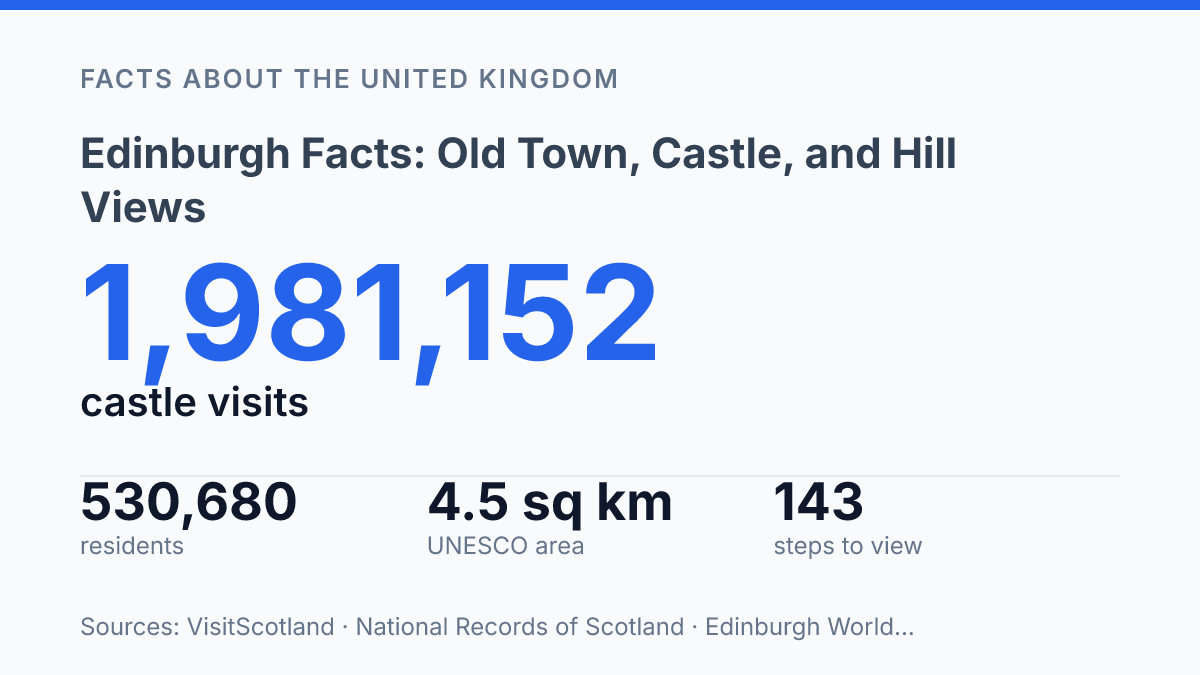
Edinburgh had 530,680 residents on 30 June 2024. Its UNESCO Old and New Towns fit into 443 hectares. The city still refuses to feel small.
That tension is the point. A medieval ridge faces a planned Georgian grid. A castle guards royal symbols above streets that drop, climb, and twist without warning.
Then Arthur’s Seat changes the scale again: an extinct volcano, 250 m high, sitting inside the capital like a dare. This guide follows the details that make the Scottish capital feel so compressed and so dramatic at once. You’ll see why the map lies a little.
In my honest opinion, the real shape of the place is learned through legs, viewpoints. The odd royal object that carries more weight than its size suggests.
Why Edinburgh feels compact but never flat
A ten-minute line on the map can feel like a stair workout in Edinburgh. Scotland’s capital has a city centre that looks manageable at first glance, with major sights packed close enough to tempt you into walking everywhere.
That instinct is usually right. It’s just not as effortless as the map suggests.
The scale is deceptive. The City of Edinburgh had 530,680 residents on 30 June 2024, making it Scotland’s second most populous council area, according to National Records of Scotland.
Yet the central experience feels compressed. Streets fold into lanes, lanes end in steps, and whole levels of the city seem to sit on top of each other.
That compression comes from the city’s split character. The Old Town rises along a steep medieval spine, with closes and stairways dropping away from it at sharp angles. North of it, the Georgian New Town feels more ordered: straighter streets, formal squares.
A calmer rhythm. But “planned” doesn’t mean flat. The dip between the two changes how you move, even when the distance looks short.
Volcanic hills are the hidden force behind the city’s shape. Ancient rock doesn’t politely follow a grid, so walking routes bend around ridges, climb over shoulders of land, and funnel people through steep passages.
You feel it on the pull from Waverley toward the Royal Mile. You feel it again when a shortcut becomes a staircase.
In my view, the city’s best trick is that it feels small without ever feeling simple. You can cross the center quickly. You rarely cross it casually.
That friction is part of the place. It slows you down, changes what you notice, and makes every view feel earned.
Old Town and New Town: two different cities in one
A few minutes can take you from a medieval lane barely wide enough for a cart to a street front built to look like classical Rome. That split isn’t cosmetic. It’s the city’s central argument, carved into stone and street plans.
The Old Town keeps the logic of a crowded medieval settlement. Its closes run narrow and tight, often dropping between tall tenements like cuts in the rock.
They weren’t designed for grand views or polite symmetry. They were made for movement, shelter, trade, and pressure.
Look closely and the plan feels almost defensive. Buildings lean into the street. Passages pinch.
Courtyards appear where you don’t expect them. The result can feel severe. That severity is exactly why the area stays in the memory.
The New Town answered that density with control. Construction began in 1767. The plan favored straight streets, balanced facades, neoclassical proportions, and formal garden squares.
It presented wealth as discipline. Space became a statement.
That order came with a message: the city wanted to look rational, modern, and confident. But elegance can flatten a place if it becomes too perfect. In my honest opinion, the New Town gives the city its polish. The Old Town gives it its pulse.
The contrast matters enough to be protected at world level. The Old and New Towns are listed together by UNESCO, not as separate curiosities but as one urban story. According to the UNESCO World Heritage Centre, the protected property covers 443 hectares, a tight area for so much architectural drama.
That shared status is the key detail. The medieval core and Georgian expansion don’t cancel each other out. They sharpen each other.
One is compressed, irregular, and shadowed. The other is measured, pale, and composed. Together, they explain why the city feels less like one planned capital and more like two rival visions forced to live side by side.
Edinburgh Castle and the symbols inside it
The view from Castle Rock sells the fortress first. The objects in its vaults do the heavier work.
Edinburgh Castle sits on Castle Rock above the city, a position that made control feel visible before anyone stepped through the gate. You don’t need a battle timeline to understand the message: height was authority.
That silhouette explains the crowds. VisitScotland recorded 1,981,152 visits to the castle in 2024, making it Scotland’s top paid attraction in that dataset.
But the stronger national symbol isn’t the wall line against the sky. It’s what Scotland chose to protect there.
The Honours of Scotland are the central payoff: the crown, sword, and sceptre used in the making of Scottish monarchs. The Crown of Scotland carries 94 pearls and 43 gemstones, and James V first wore the refashioned crown in 1540, according to Historic Environment Scotland.
That detail matters because these aren’t decorative museum pieces. They’re instruments of sovereignty.
The Stone of Destiny adds the harder edge. Scottish rulers were inaugurated with it at Scone before it was taken south in 1296, turning a coronation object into a national argument. It came back to Scotland in 1996 and was displayed at the castle for decades.
There’s a catch, though. The Stone moved to Perth Museum in 2024, with Historic Environment Scotland confirming it will still return to Westminster for future coronations.
So the castle’s symbolic claim has changed slightly: it remains bound to the Stone’s story. It no longer holds the stone every visitor once expected to see.
That tension makes the place sharper, not weaker. The fortress is the city’s most obvious emblem, yet its real force comes from portable objects: a crown, a sceptre, a sword, a block of sandstone. In my humble opinion, that’s why the display rooms matter more than the postcard outline.
Arthur’s Seat and Calton Hill: the views that define the city
The wildest summit near the centre is not a mountain at all. The hardened remains of a volcano. Arthur’s Seat rises inside Holyrood Park with a rough, exposed profile that makes the city feel suddenly less urban. According to Historic Environment Scotland, the wider volcanic system erupted around 340 million years ago.
That height matters in the body as much as the eye. At 820 ft / 250 m, the climb is short by hillwalking standards. It asks for real effort.
The paths can be uneven, the wind can bite. The reward feels earned rather than staged.
Calton Hill gives a completely different kind of view. It is smaller, more composed, and packed with stone signals of civic ambition. The National Monument dominates that message: grand, unfinished, and impossible to ignore.
Its monuments and memorials turn the hill into an open-air statement. The Nelson Monument adds a practical twist, since its time ball was added in 1852 and the viewing level sits above 143 steps, according to the city’s Museums & Galleries service. The Dugald Stewart Monument brings a more elegant note, framing the skyline with deliberate classical drama.
Look north. The Firth of Forth pulls the whole scene outward. The water stops the view from feeling enclosed.
Roofs, domes, spires, hills, and sea all sit in one sweep. You understand the city as a place built between geology and ceremony.
This contrast is the point. Arthur’s Seat feels wild and physical, but Calton Hill feels formal and commemorative. In my view, that split explains the city better than any single landmark can: one side is raw rock and weather, the other is memory, monument, and self-conscious display.
What the hills teach you after the map stops helping
The smartest plan is not to see more. It’s to change height before you change district.
Start low, then climb. Let the capital rearrange itself from a close, a rampart, a volcanic path, or the Nelson Monument’s 143 steps. The tradeoff is simple: you’ll cover less ground, but you’ll understand far more of it.
Some symbols don’t stay put. The Stone of Destiny moved to Perth Museum in 2024, then still keeps its coronation role. That matters.
In my humble opinion, the city’s power isn’t locked inside one building or one view. It moves between objects, slopes. The people willing to look twice.
Frequently Asked Questions
Q: What is Edinburgh best known for?
A: Edinburgh is known for its medieval Old Town, elegant Georgian New Town. The castle that sits high above the city. The contrast is the point… old stone lanes on one side, wide planned streets on the other. In my view, that mix is what gives the city its edge.
Q: Can you visit Edinburgh Castle?
A: Yes. You should if you care about Scottish history. The castle holds Scotland’s crown jewels and the Stone of Destiny, which was used in the coronation of Scottish rulers. It matters because this isn’t just a fortress. It’s a place packed with symbols of power.
Q: What are the best views in Edinburgh?
A: Arthur’s Seat gives you the broadest sweep, with the city spread out below from a real hill rather than a polite lookout. Calton Hill is easier to reach and gives you monuments as part of the view… that’s a different kind of payoff. If you want drama, Arthur’s Seat wins.
Q: How big is Edinburgh compared with other capitals?
A: Edinburgh is compact. You can see a lot without covering huge distances. That helps if you want to move between the Old Town, the New Town. The hills in one day. The tradeoff is simple: the steep streets can make short walks feel longer than they look.
Q: What’s the difference between the Old Town and the New Town?
A: The Old Town is medieval and tight, with narrow streets and a more crowded feel. The New Town is Georgian, with gardens and neoclassical buildings laid out more neatly. In my honest opinion, the contrast is the city’s strongest feature, because it shows two very different ideas of Edinburgh in one place.