
The United Kingdom added 755,300 people in one year. The map still misleads people before the journey even starts. The 2025 ONS bulletin shows growth across all four nations, but England still carries the weight: most people, most tourism spend, and most of the outside attention.
That imbalance matters. Scotland holds nearly a third of the land but only a small share of the population.
Wales can feel wetter, brighter, or darker in ways a London forecast won’t explain. Northern Ireland adds another layer of history, border logic, and identity.
In my honest opinion, the mistake is treating the country as one neat package. Stonehenge, Bath, London, coastlines, capitals, and weather patterns all tell a less tidy story. That’s where the real facts start to get useful.
What countries make up the United Kingdom?
Four national identities sit inside one legal country. That is the detail that makes the map less simple than it looks.
The United Kingdom is a sovereign state made up of four constituent countries: England, Scotland, Wales, and Northern Ireland. They aren’t colonies or provinces in the everyday sense. They have their own histories, flags, teams, legal traditions, and in some areas, their own governing institutions.
Great Britain is not the same thing. Great Britain refers only to the island that contains England, Scotland, and Wales. It leaves out Northern Ireland.
That distinction sounds fussy. It prevents one of the most common mistakes people make when reading a map, booking travel, or talking about nationality.
The capital of the United Kingdom is London. It sits in England.
That gives England a heavy pull in politics, media, and visitor attention. But the state is bigger than England, and reducing it to London misses the structure that holds the whole thing together.
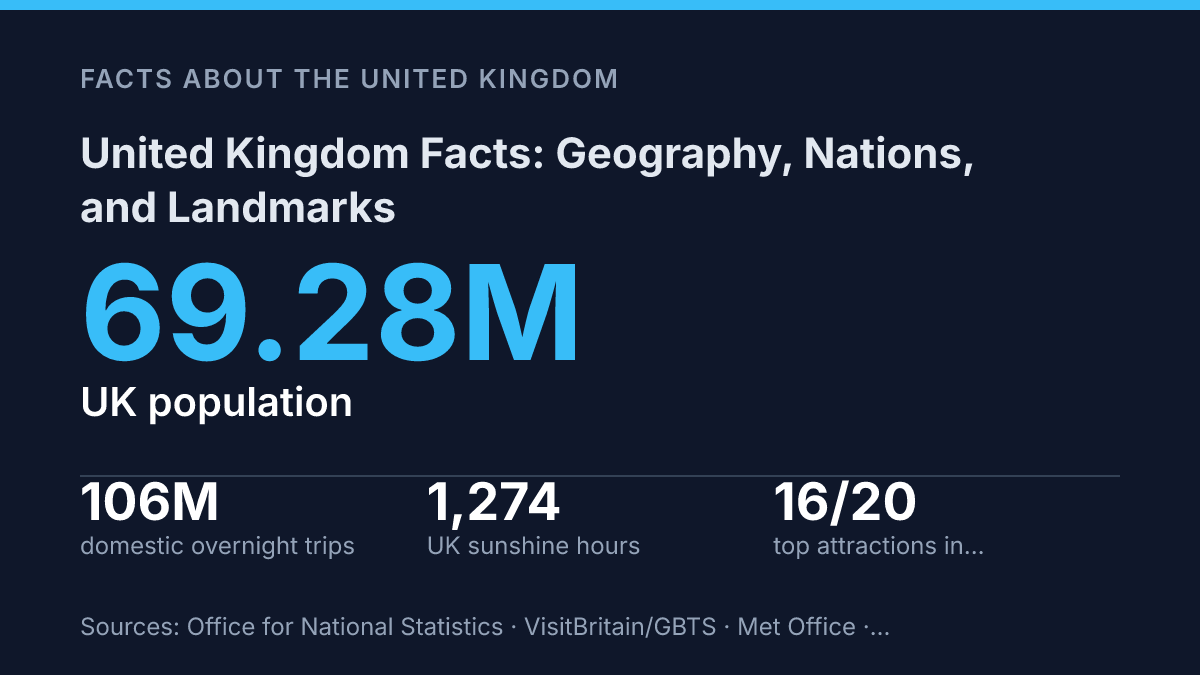
According to the Office for National Statistics, the population reached 69,281,400 in the 2025 mid-2024 bulletin. That was up 755,300 people, or 1.1%, in one year; England grew 1.2%, Scotland 0.7%, Wales 0.6%, and Northern Ireland 0.4%. This adds a blunt reminder: one state does not mean equal weight.
The obvious story is unity. The real interest is how four countries share one state without giving up their separate identities. In my view, that tension is the most useful way to understand the UK: it is politically one country, but culturally it never speaks with just one voice.
Why geography shapes travel, weather, and identity
The English Channel has shaped the country as much as any border on land. The United Kingdom is an island nation in northwestern Europe, set between the Atlantic edge of Europe and the busy seas that link the continent to the wider world.
Water frames the place on every side. The English Channel lies to the south, the North Sea to the east. The Irish Sea between the main island and Ireland.
That geography made the country harder to invade and easier to trade with. It also made daily movement depend on ports, crossings, tides, and later tunnels and airports.
The weather follows the same logic. Air arrives off the ocean more often than from deep inland, so temperatures stay milder than the latitude might suggest. Winters rarely match the severity of continental Europe, and summers don’t usually carry the same dry heat.
The tradeoff is rain. A lot of it.
Western areas feel that maritime climate most sharply. Moist air comes in from the Atlantic, rises over higher ground, and drops rain before moving east. That’s why the west can feel soft, green, and soaked, while eastern areas tend to be drier by comparison.
Recent data backs up the national stereotype without turning it into a joke. In 2024, the Met Office recorded 1,274 sunshine hours across the UK, only 91% of the 1991–2020 average.
That figure matters because it shows how climate affects more than small talk. It shapes farming, building habits, outdoor plans, and even the national habit of carrying on through bad weather.
Geography also feeds identity. Island status can create confidence, distance.
A strong sense of separateness from mainland Europe. But separation isn’t isolation. In my honest opinion, the real character comes from that contradiction: protected by water, connected by water, and never fully free from what the sea decides.
Why England gets most of the attention
England’s dominance is not just a feeling: in ONS mid-2023 estimates, it held 84.5% of the UK’s population, with 57,690,300 people out of 68,265,200. That scale gives it more political weight, more media reach, and more everyday visibility than the other nations in the union.
Size isn’t the whole story. It explains why outsiders so often hear an English accent first.
London sharpens that imbalance. The capital is a major global centre for finance and culture, so decisions, money, publishing, theatre, broadcasting, and diplomacy all gather there at unusual density. ALVA’s 2024 visitor figures show the pull clearly: 16 of the top 20 listed visitor attractions were in London.
That doesn’t make London the whole country. It does mean the city acts like a giant amplifier.
Culture adds another layer. Shakespeare gave England a literary export that still fills school syllabuses, theatres, film scripts, and everyday phrases far beyond Britain. The Beatles did something similar in the 1960s, but through sound rather than stagecraft. Their music turned Liverpool into a global reference point and helped make English popular culture feel modern, portable, and commercially powerful.
Academic reputation works the same way, only with older roots. Oxford and Cambridge are centuries-old universities. They still shape how the country is seen abroad.
They attract students, produce political and scientific leaders, and project an image of tradition that sells well. The catch is obvious: prestige can flatten complexity. It can make one version of Englishness look like the national story.
That’s the tension at the centre of England’s visibility. England drives much of the global image.
That fame can hide the rest of the union from view. In my humble opinion, the mistake is not noticing England’s influence. The mistake is treating that influence as if it explains everyone else too.
Stonehenge, Bath, and other places that anchor the story
Stonehenge still pulls more than a million people a year to a field in Wiltshire, despite offering no palace, throne room, or written origin story. The stone circle belongs to the Neolithic world of southern England, long before Rome, parliament, or the modern state existed. ALVA recorded 1,363,252 visits to the site in 2024, a number that shows how powerfully mystery can compete with grand architecture.
Its status isn’t just local pride. UNESCO inscribed Stonehenge, Avebury and Associated Sites in 1986, grouping the monument with a wider ritual landscape rather than treating it as a lone ring of stones.
That matters. The site makes more sense as part of a prehistoric network of burial mounds, avenues, and earthworks. In my view, that wider setting is what gives Stonehenge its real force.
Bath tells a different story: conquest, engineering, and comfort. The Roman Baths grew around natural hot springs after Rome absorbed this part of Britain, turning the city into a spa settlement tied to ritual and public life. But Bath isn’t only Roman.
Its later Georgian terraces sit close to the ancient baths. The city feels layered rather than frozen in one period.
Oxford and Cambridge add another kind of permanence. Teaching at Oxford is documented by 1096, and Cambridge took shape in 1209 after scholars left Oxford during a dispute.
Their reputations now stretch far beyond classrooms. They stand for academic power, social status, and continuity… but also for exclusion, privilege, and debate over who gets access to elite institutions.
That contrast is the point. A prehistoric circle, a Roman spa, and two old university cities all help define the same country, yet none tells the whole story alone. The surprise is how close the old and the new sit together.
You don’t move through neat chapters here. You move through layers that keep interrupting each other.
What the map still hides after the names make sense
When London held 16 of the top 20 listed visitor attractions in 2024, it didn’t prove the rest of the country was secondary. It proved attention is not the same as understanding.
The smartest way to read the United Kingdom is to plan by contrast. Pair the obvious with the overlooked. Put a major landmark beside a border, a weather shift, or a national difference you can feel on the ground.
In my humble opinion, that’s when the facts stop being trivia. They become a better way to travel, read the news, and notice what a single name can hide.
Frequently Asked Questions
Q: What countries are part of the United Kingdom?
A: The United Kingdom has four countries: England, Scotland, Wales, and Northern Ireland. That’s the core fact people miss. The split matters because each one has its own identity. They share one sovereign state.
Q: Is the United Kingdom an island nation?
A: Yes. It sits in northwestern Europe and is made up of the island of Great Britain plus the northern part of Ireland. That geography shapes everything from travel to weather… and it also explains why the sea is so central to its history.
Q: Why is London so important in the United Kingdom?
A: London is the capital. It carries real weight as a global centre of finance and culture. London sits in England, the country that anchors much of the UK’s political and economic life. The city matters because decisions made there ripple far beyond the capital.
Q: What are the most famous landmarks in England?
A: Stonehenge stands out first, and it’s one of the best-known prehistoric sites in the country. Bath’s Roman spa and the universities at Oxford and Cambridge are just as important, but for different reasons. Stonehenge dates to about 3000 BCE. That age gives it a pull modern landmarks can’t match.
Q: Which places in the UK are linked to Shakespeare and The Beatles?
A: England is the birthplace of both Shakespeare and The Beatles, so those names sit at the center of its cultural story. That connection gives the country more than political history. It has deep literary and music influence too. Shakespeare remains one of England’s biggest cultural exports. That still shapes how people see the country.