
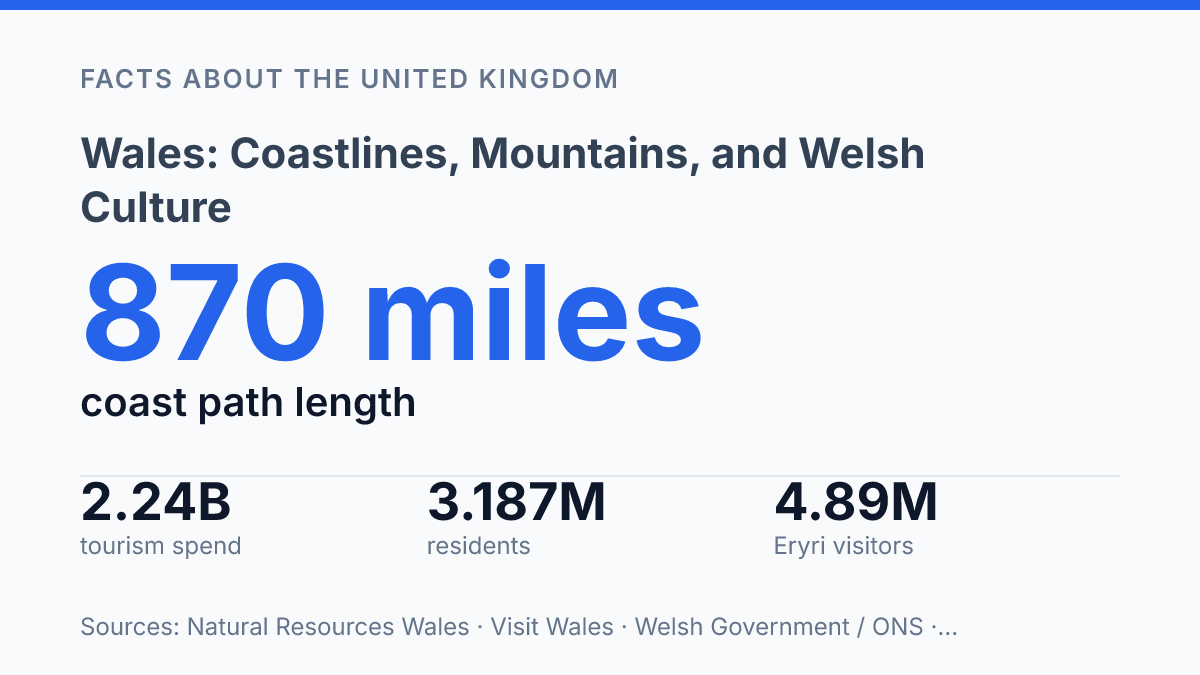
Wales fits about 3.187 million people into a country where an 870-mile coast path can pull you from borderlands to cliff towns, then into mountains before dinner. That scale matters. It makes the place feel compact, but never small.
The surprise is the contrast. Cardiff has a castle earning millions again, a waterfront reshaped by a £2.4 billion regeneration. A night economy strong enough to hold Purple Flag status into 2025.
A few hours away, Eryri turns lakes, peaks. A mountain railway into one of Britain’s clearest nature escapes.
This guide follows the country through geography, capital-city energy, mountain drama, and language. The Welsh thread is the part that changes everything. In my honest opinion, Culture here isn’t decoration for visitors. It’s the reason the coast, castles, and peaks feel rooted rather than staged.
Where Wales sits in Great Britain
Wales occupies the southwest edge of Great Britain, but its shape on a map tells you less than its terrain does. It shares the island with England and Scotland, with the Irish Sea and Bristol Channel giving it long western and southern edges.
That coastal exposure isn’t just scenic. It has pushed towns, ports, roads, and visitor routes toward the margins of the country.
The scale can mislead you. The Welsh Government and ONS put the population at 3.187 million on 30 June 2024. The country is smaller than many large metro areas.
Yet moving through it rarely feels simple. Sea cliffs, estuaries, river valleys, and upland ridges break short distances into slower journeys.
That contrast explains a lot about travel here. Natural Resources Wales says the coastal path runs 870 miles from near Chester to Chepstow, a huge distance for a compact country. Inland, mountain areas pull routes into valleys and passes.
You don’t just cross the map. You negotiate it.
Regional differences appear fast. The south has the strongest urban pull, with Cardiff and nearby coastal towns anchoring daily life and transport.
The west feels more maritime and exposed. The north and interior lean harder into uplands, stone villages, lakes, and roads that bend around the land rather than cutting through it.
In my view, that compact-but-stretched feeling is the key to understanding the place. A short drive can move you from city streets to sheep country, then to a headland where the weather seems to arrive from nowhere.
It looks small. The terrain makes it feel bigger… and that is part of its appeal.
Cardiff’s castle, waterfront, and night scene
Cardiff became the official capital in 1905, a late promotion for a city that now carries itself with real confidence. That timing matters.
The capital status didn’t create Cardiff’s character from nothing. It sharpened a port city into the political and cultural front door of Wales.
Inside Cardiff Castle, the surprise is how theatrical the place feels. The Roman and Norman layers give it age. The ornate Gothic Revival interiors steal the show with painted ceilings, carved detail, and rooms that feel more like fantasy than fortress. In my honest opinion, that tension is what makes the castle matter: it isn’t just old, it’s deliberately dramatic.
That drama lands harder because the castle sits in the middle of the modern city rhythm. Buses, shops, offices, pubs, students, and gig crowds move around walls that belong to a different century.
Cardiff feels polished and lively. The medieval landmark never lets the present fully take over.
The waterfront adds a second version of the city. Cardiff Bay gives the capital a broader, glassier face, with restaurants, performance spaces, and public squares built from old dockland energy. It can feel planned, even tidy, but that’s the tradeoff of regeneration: some grit gets cleaned away as access improves.
After dark, Cardiff works best when you stop treating it like a checklist. The centre has the easy pace of a compact capital.
A castle visit, dinner, and late drinks don’t require heroic planning. Its night scene has range too, from theatre crowds to student-heavy streets.
Growth gives the city its edge. The 2021 census counted 335,145 residents in Cardiff, and recent estimates show the pull continuing: the country had about 3,187,000 residents on 30 June 2024, up 0.6% from mid-2023, with Cardiff among the fastest-growing local authorities at +1.1%, according to Welsh Government / ONS. You can feel that pressure in the city’s mix of heritage, waterfront polish, and late-night noise.
Snowdonia’s peaks, lakes, and railway
A mountain you can reach by train still makes walkers sweat for the same view.
Snowdonia National Park was designated in 1951, and its appeal is sharper than a simple “high places” label. The park protects 214 square miles of mountain, lake, and valley scenery, shaped by ice rather than decoration. You see it in the scooped cwms, cold-looking tarns, and ridgelines that feel cleanly cut.
The main pull is Mount Snowdon, the highest peak in Wales. Hikers reach it by several routes, and each one changes the day. The Llanberis Path gives the most gradual ascent.
The Pyg Track feels more direct and rocky. The Miners’ Track starts gently beside lakes, then turns serious near the upper slopes.
That variety matters. Snowdonia doesn’t reward only the strongest walkers. It rewards people who choose well.
Weather can turn quickly, even when the valley feels mild. A summit plan that looks easy over breakfast can feel very different in cloud, wind, and loose stone.
Then there’s the Snowdon Mountain Railway. It runs from Llanberis toward the summit and gives many visitors a way up without committing to the full climb. That access is a gift for families, older travelers, and anyone short on time.
But convenience changes the experience. The view feels different when your legs have earned every switchback. In my humble opinion, the railway is part of Snowdonia’s charm.
It shouldn’t replace the slower routes if you’re fit enough to walk them. Not everyone wants their hardest-earned view delivered that neatly.
Visitor pressure proves the pull. Eryri National Park Authority recorded 4.89 million visitors in 2023, a figure that shows how strongly this mountain country anchors nature tourism. The best days here still come with restraint: start early, respect weather warnings, and leave the path better than you found it.
Welsh language and Celtic identity
A language can appear on nearly every road sign and still be unevenly spoken at the kitchen table. That tension sits at the heart of modern Welsh identity. The 2021 Census, reported by the Office for National Statistics, counted 538,300 residents aged three and over who could speak the language, equal to 17.8% of that age group.
Welsh is not kept behind museum glass. You meet it on public signs, in school classrooms, on government services, and across broadcasting.
S4C gives the language a national television platform, and BBC Radio Cymru keeps it present in everyday media. That visibility matters, but visibility is not the same as fluency.
Regional differences are sharp. In some northwestern and western communities, you’ll hear the language in shops, schools, chapels, and sports clubs.
In other areas, it appears more as a formal public marker than a daily habit. Preservation matters, but living use matters more.
The native name, cymraeg, carries more than grammar and vocabulary. It signals a Celtic inheritance that links the country to older Brythonic roots, place names, poetry, music, and political self-confidence. In my view, the strongest part of that identity is not nostalgia. It’s the decision to keep using the language in ordinary life.
That choice is never simple. English dominates work, entertainment, and much online culture, so Welsh-language education and media have to compete for attention every day.
Yet the language still gives the country a cultural edge that can’t be copied by scenery, castles, or tourism campaigns. If you want to understand what makes this nation distinct, listen for the words people choose when nobody is performing for visitors.
What careful travellers notice after the famous views
The smarter way to approach this trip is to treat distance as the gift. In 2024, domestic overnight visits were down 10%, but visitor spend rose 11%. That shift says something.
People aren’t just passing through. They’re choosing more carefully.
That creates pressure too. Eryri had 4.89 million visitors in 2023. The most loved places can feel crowded fast.
Go slower. Build in a Welsh-language venue, a less obvious coastal walk, or a night in a town that isn’t on every first-timer’s list.
In my humble opinion, the country rewards attention more than ambition. If you only chase the famous views, you’ll miss the quieter truth: the strongest memory may be the word you hear, not the summit you photograph.
Frequently Asked Questions
Q: What is Wales best known for?
A: Wales is known for its rugged coastline, mountain scenery. A strong Celtic identity. The Welsh language still shapes daily life. That matters because it gives the country a clear personality instead of a generic British feel. In my view, that’s what makes it stand out so sharply.
Q: Is Cardiff worth visiting on a trip to Wales?
A: Yes. Cardiff mixes a coastal setting with a real city energy. You get both nightlife and history in one place. Cardiff Castle is the big draw… especially if you like medieval walls paired with ornate Gothic Revival interiors.
Q: What can you do in Snowdonia National Park?
A: Snowdonia National Park is built for hikers. It isn’t just about walking trails. You’ll find lakes, glacial landforms. A railway that goes up to the peak of Snowdon. That mix is the surprise. You can get a mountain experience without climbing every step.
Q: When is the best time to go to Wales for outdoor trips?
A: Late spring through early autumn is the easiest window for hiking and coastal exploring. The weather can still change fast, so pack for rain even when the forecast looks decent. Wales rewards flexibility more than perfect planning.
Q: Do people speak Welsh in Wales?
A: Yes, and you’ll hear it in daily life, not just on signs. The language is a major part of Welsh culture. It gives the country a different feel from the rest of Great Britain. In my honest opinion, if you care about local identity, that’s one of the strongest reasons to visit.