
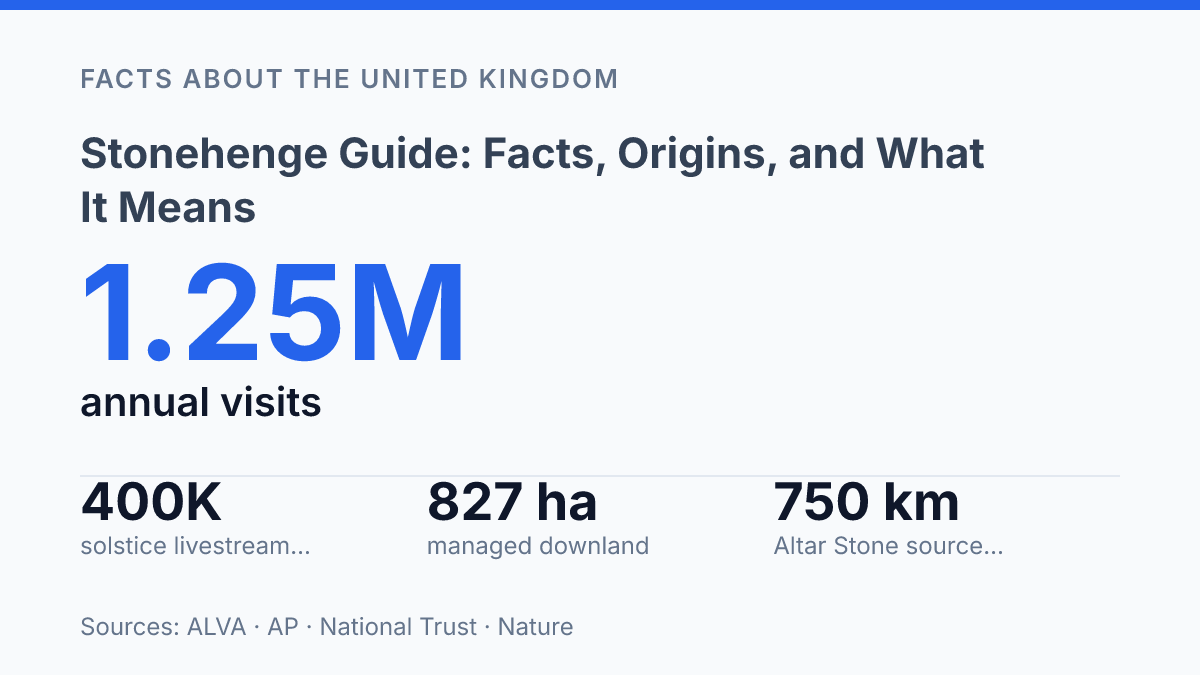
Stonehenge just got stranger: in a 14 August 2024 study, Nature traced its 6-tonne Altar Stone at least 750 km to northeast Scotland.
That single finding breaks the tidy postcard version of the monument. The stones on Salisbury Plain were part of a wider ritual world, not a lonely ring beside the A303.
Look at the scale and the puzzle changes. The National Trust manages 827 hectares inside the World Heritage Site. UNESCO frames the area as about 2,000 years of monument-building, from earthworks to avenues to huge timber circles.
This guide treats the site that way. You’ll see what stands there, how 25-ton sarsens were moved and jointed, why archaeologists still argue over ceremony and burial, and how to visit without missing the details hiding in plain sight. In my honest opinion, the biggest mistake is treating the stones as the whole story.
What Stonehenge is and where it stands
From far off, Stonehenge can look like a few uprights on a bare ridge. That bare chalk setting is one reason scholars treat its placement as deliberate.
The monument stands on Salisbury Plain in Wiltshire, England, about two miles west of Amesbury. That puts it in open country, not beside a town center or hidden in a valley.
At its core, this is a prehistoric megalithic structure made from standing stones arranged in concentric settings. You’re not looking at a random scatter of rocks. The surviving stones form planned rings and horseshoe-like arrangements, with gaps, sightlines, and spacing that still shape how the site is read.
The surrounding ground matters as much as the stones. The National Trust manages 827 hectares of downland within the World Heritage Site, including more than 800 hectares of species-rich chalk grassland. That scale changes the mental picture.
The famous circle is the focal point. It sits inside a much wider ancient setting.
Its formal status reinforces that point. The monument is part of the Stonehenge and Avebury UNESCO World Heritage Site, inscribed in 1986, which links it with another major prehistoric complex in Wiltshire. In my view, Treating it as only a stone circle misses the most important clue: the land around it was part of the design, not empty background.
That contrast is easy to overlook. Simple from a distance.
Precise up close. The site’s power starts with that tension.
How the stone circle was built
The strangest transport problem is this: the smaller stones travelled farther than the giants. The bluestones came from the Preseli Hills in west Wales.
The larger sarsens came from much nearer sources in southern England. That reversal still matters, because size alone doesn’t explain the effort behind the build.
Work began around 3000 BCE with an earthwork phase. According to English Heritage, the first major form was a circular enclosure about 100 metres across, with 56 pits that may have held timber posts or stones. This was not yet the famous stone setting people picture now.
The major stone phase came later, around 2500 BCE. Builders brought in the sarsens and shaped them into uprights and lintels, creating the most technically striking parts of the circle. English Heritage says the sarsens averaged 25 tons, so even the “nearby” stones demanded planning, labour, and control.
The joinery is the detail that separates this monument from a simple ring of raised rocks. The builders carved mortise-and-tenon joints so upright stones could lock into the lintels above them. They also used tongue-and-groove joints between lintels, a woodworking idea translated into stone with punishing precision.
Between roughly 2400 and 2000 BCE, the arrangement kept changing. Bluestones were moved, reset, and worked into new patterns as the monument took on its more complex final form. That slow sequence matters more than any single dramatic building moment… this was a long project, not one heroic weekend of prehistoric engineering.
The tension is obvious but easy to miss. The heaviest stones did not travel the farthest.
The farthest stones were not the biggest. In my honest opinion, that mixed supply chain is the best clue to the builders’ ambition: they weren’t just solving a practical problem. They were choosing materials with meaning, even when those choices made the work harder.
What archaeologists think it was used for
The strongest clue to the monument’s purpose is not in the sky, but in burned bone. English Heritage records 64 cremation burials at or near the circle, a number that makes the place look less like a simple observatory and more like a cemetery for selected dead.
Those burials don’t solve the case. They raise sharper questions. Who deserved burial there?
Family leaders, ritual specialists, outsiders, ancestors claimed by a community? The remains show repeated funerary use. They don’t give names, ranks, or beliefs.
The astronomy is real, though. The main axis lines up with the summer solstice sunrise in one direction and the winter solstice sunset in the other.
On the winter solstice, around 21 December today, the sun drops along the same broad line in reverse. That precision was not accidental.
In my humble opinion, the burial evidence is stronger than the sun-worship story alone… and that’s the part many visitors miss. A solar alignment tells you when people gathered. It doesn’t tell you whether they came to mourn, feast, mark time, claim ancestry, or do all of that at once.
The contrast with Durrington Walls makes the ritual picture richer. Excavations there uncovered traces of houses and large-scale feasting, so archaeologists treat it as a possible place of the living. The stone circle, by contrast, may have been tied more closely to the dead.
That split is powerful. It can be too neat. People don’t divide life, death, food, travel, and ceremony into tidy modern boxes.
The evidence points to procession, seasonal gathering, funerary rites, and sky-watching. It does not hand us a single label.
How to visit without missing the key details
The most revealing view may come from the last few metres you’re not allowed to cross. On a normal visit, you can stand close enough to feel the scale of the stones. You still can’t touch them or walk freely through the centre.
That restriction frustrates some visitors. It also forces you to read the monument from the outside, where its mass, spacing, and broken symmetry become easier to notice.
Start at the English Heritage-managed Stonehenge Visitor Centre, not because the building is the main event, but because it gives the stones context before you see them. The exhibits help you connect the circle with the people who moved, shaped, buried, gathered, and watched there. In my view, the visit makes far more sense when you treat the centre as part of the experience, not as a gift-shop obstacle.
From there, a shuttle transfer runs visitors from the centre to the stones. You can also walk if conditions and time allow. The shuttle has one clear advantage: it makes the sudden arrival feel sharper.
One minute you’re in a managed visitor area. A few minutes later, the stones appear with no city, tower, or modern skyline competing for your attention.
Look past the obvious photo angles once you arrive. Watch how the upright stones change shape as you move around the path. Notice the gaps as much as the surviving blocks.
The empty spaces matter, since they reveal missing stones, collapsed pieces. A structure that was never meant to be understood from one single viewpoint.
Solstice gatherings are the big exception to the usual rhythm of visiting. In 2025, about 400,000 people watched the summer solstice livestream, and AP reported that about 25,000 attended in person. Access rules change for those events, including rare opportunities to be among the stones.
The arrangements are different from standard daytime visits. Check the official guidance before you build plans around that experience… it isn’t just a regular ticket with a sunrise attached.
What the stones ask of you now
2025 showed the modern pull clearly: AP reported about 400,000 people watched the solstice livestream, even as only a fraction stood on the grass at dawn. That gap matters.
Screens can show the sunrise. They can’t show the slope of the land under your feet.
If you visit Stonehenge, spend less time chasing the perfect front-on photo. Walk the wider setting. Notice the Avenue, the horizon, the empty spaces.
The hardest truth is also the best one: nobody has solved the place completely. In my humble opinion, that uncertainty is not a flaw in the guide. It’s the reason the visit stays with you.
Frequently Asked Questions
Q: What is Stonehenge, exactly?
A: Stonehenge is a prehistoric megalithic structure on Salisbury Plain in Wiltshire, England. It sits two miles west of Amesbury. That location matters, because the monument was built in a landscape people were using long before tourists arrived.
Q: How old is Stonehenge?
A: The site began taking shape around 3000 BCE, then changed over many centuries. That long build time explains why people expect one clear story and don’t get it. In my view, that uncertainty is part of its power.
Q: Who built Stonehenge?
A: No single person built it. Different groups likely added to it over time, and that’s why the monument doesn’t read like one clean project. The surprise is how coordinated it still feels.
Q: Why was Stonehenge built?
A: There isn’t one accepted answer. People have linked it to ritual, burial, astronomy, and ceremony, but none of those ideas fully explains everything on the site. That mix is exactly why it still draws debate.
Q: Can you visit Stonehenge today?
A: Yes, you can visit it on Salisbury Plain in Wiltshire. The main stones are protected. You won’t wander freely through the circle, but that’s the tradeoff for keeping it intact. If you want the best experience, plan ahead and expect crowds at peak times.