
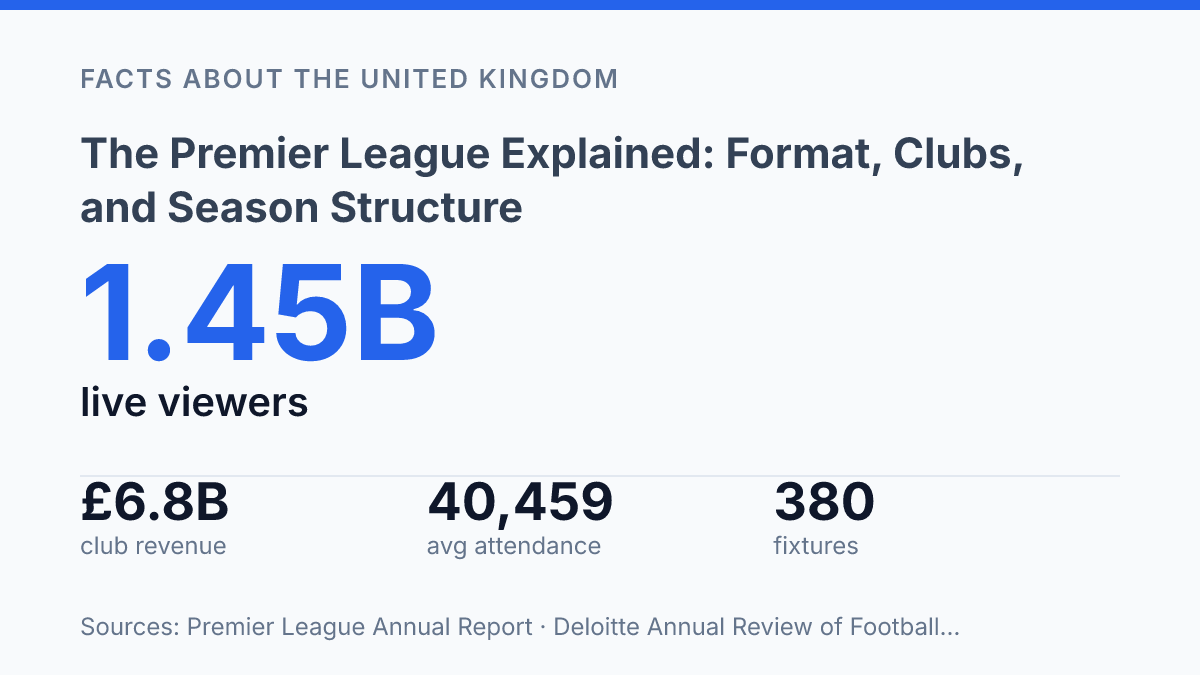
The Premier League fits 20 clubs, 380 fixtures and a 282-day 2024/25 season into a format where only three places change hands each year. That combination of stability and risk explains much of its pull: most clubs remain in place, yet one poor campaign can send a side into the EFL Championship, while one successful Championship play-off run can be worth at least £140 million over three seasons, according to Deloitte.
The competition is not only a league table but a weekly national event, with 2024/25 stadiums reported at 98.8% full and an average attendance of 40,459. This guide explains how the league sits at the top of English football, how clubs move in and out, how the fixture calendar works, and why its structure carries such weight for supporters, broadcasters and clubs.
What the league is and where it sits in English football
The Premier League is based in one national football system, yet its annual report says 1.45 billion people watched live matches in 2024/25. That scale explains why the competition is often discussed as both an English domestic league and an international sports property, with clubs, players, managers, and broadcast coverage followed far beyond the UK.
At its core, the competition is a professional association football league in England and the highest level of the English football league system. It sits at the summit of the country’s league pyramid, above the divisions run by the English Football League, with the Championship immediately beneath it. This placement matters because it identifies the league as the top tier of regular club football in England, rather than a cup tournament or a one-off event.
The league is contested by 20 clubs, each operating as a professional team within the same national structure. Those clubs are ranked through league performance over a season, which creates a single table used to distinguish title contenders, mid-table sides, and teams at the lower end of the standings. The format details sit within that broader framework: a fixed group of clubs competing in the top division of English league football, while also carrying commercial and cultural weight that extends well beyond England.
How promotion and relegation work
Only three clubs in a 20-team division change places each year, yet those places decide whether a club spends the next season inside the country’s richest league competition or outside it. Within a modern Premier League season, the competition comprises 20 clubs and 380 matches, and in 2024/25 it lasted 282 days from 16 August 2024 to 25 May 2025, according to Premier League. Promotion and relegation attach that long league campaign to the wider structure run below it by the English Football League.
At the end of the season, the clubs finishing 18th, 19th and 20th move down into the EFL Championship. They are replaced by three clubs coming up from that division: the top two finishers gain automatic promotion, while the final place is awarded through the Championship play-offs. This means membership is not fixed from one season to the next, even though most clubs remain in place in any given year.
The practical effect is a clear change in sporting status. A promoted club enters the top division’s fixture list, commercial environment, and competitive standard, while a relegated club must adjust to a different set of opponents, revenue conditions, and squad-building assumptions. The system keeps movement possible between levels, but it also makes the lower end of the table highly consequential because finishing position can alter a club’s operating model for the following season.
The financial stakes help explain why promotion and relegation carry such pressure. Deloitte Sports Business Group estimated in 2024 that the Championship play-off winner would receive at least £140 million in revenue uplift over three seasons, rising to about £305 million if the club survived its first season after promotion. That does not make sporting success purely financial, but it shows why the final promotion place and the relegation places are among the most closely watched parts of the season.
Season calendar, match count, and fixture rhythm
A full league season contains 380 fixtures, yet every club’s schedule is built from the same simple home-and-away pattern. According to league materials, the campaign usually runs from August to May, giving clubs roughly nine months to complete their domestic league programme. That span creates a long-form competition rather than a short tournament, so consistency across different weather, injury, and form cycles matters as much as isolated results.
Each club plays 38 matches: two against every other club, one at home and one away. This format gives the table a balanced structure because every pairing is repeated in reversed conditions. It also means the fixture list has a predictable mathematical shape, even though the order of opponents and the timing of difficult runs can vary from one season to the next.
Most games are staged on weekend afternoons, which gives the season its familiar weekly rhythm. Occasional weekday evening fixtures are also part of the calendar, often used when cup competitions, European commitments, winter congestion, or postponed matches require the schedule to be adjusted. Those midweek games do not change the basic format, but they can affect travel plans, recovery time, and viewing routines because clubs and supporters have less space between matches than in a standard weekend-to-weekend cycle.
Why the competition matters to UK football fans
According to UK Parliament written evidence, 34 million people in the UK watched live matches or BBC Match of the Day coverage in 2024/25, equivalent to 55% of the total UK television audience. That domestic reach helps explain why the competition is not only a sporting calendar but a recurring point of reference in British football conversation, from stadium matchdays to post-match analysis and Monday debate.
The Premier League has this pull because it is the top domestic competition in England, so performances there carry the highest national visibility for English clubs. Its structure also sustains attention over time: a field of 20 clubs and a 38-match season create a long table-based campaign in which form, injuries, managerial decisions, and fixture sequences can alter perceptions week by week. Unlike a cup competition, where one defeat can end involvement, the league format keeps clubs in a continuing argument with the table.
That continuity gives ordinary fixtures domestic weight. A match between teams outside the title race can still matter because it affects league position, supporter confidence, managerial pressure, and the mood around a club. The same prominence that makes the top tier so visible also sharpens scrutiny, since every result is interpreted against expectations built over months rather than in isolation.
Fixture timing reinforces this weekly rhythm for UK fans. Weekend afternoon matches provide a regular point around which supporters follow team news, attend games, or track results across the division, while weekday evening fixtures create shorter bursts of attention that interrupt the working week. The result is a competition whose importance comes not only from status, but from repetition: the season gives supporters a shared domestic schedule, a constantly updated table, and a steady sequence of results to interpret.
Why every league position carries more than points
The league table is also an economic map. A club finishing 17th and a club finishing 18th may be separated by only a few points, but the financial and sporting consequences can run for years. That is why the format remains easy to understand yet difficult to reduce to a simple schedule of matches.
Its value comes from repeated pressure: weekly fixtures, limited places, full stadiums and a promotion system that keeps the Championship closely connected to the top tier. As broadcast deals, matchday income and regulatory scrutiny keep growing, the most practical way to understand English football is still to begin with the table and ask what each position makes possible.
Frequently Asked Questions
Q: How many teams are in the Premier League each season?
A: The league has 20 clubs each season. Each club plays the others twice, once at home and once away, which creates a 38-match schedule for every team.
Q: How does promotion and relegation work in the Premier League?
A: It sits at the top of the English football league system and uses promotion and relegation with the English Football League (EFL). The best-performing EFL clubs move up, while the lowest Premier League clubs can move down at the end of the season.
Q: When does the Premier League season usually start and finish?
A: Seasons usually run from August to May. That schedule aligns the competition with the wider English football calendar and leaves room for domestic cup fixtures and international breaks.
Q: How many matches does each Premier League club play?
A: Each club plays 38 matches. The fixture list is double round-robin, so every team faces every other team twice, once at home and once away.
Q: Why are most Premier League matches played on weekends?
A: Most games are scheduled for weekend afternoons to fit broadcast, stadium, and travel patterns across the season. A smaller number are moved to weekday evenings, usually to accommodate television coverage or fixture congestion.