
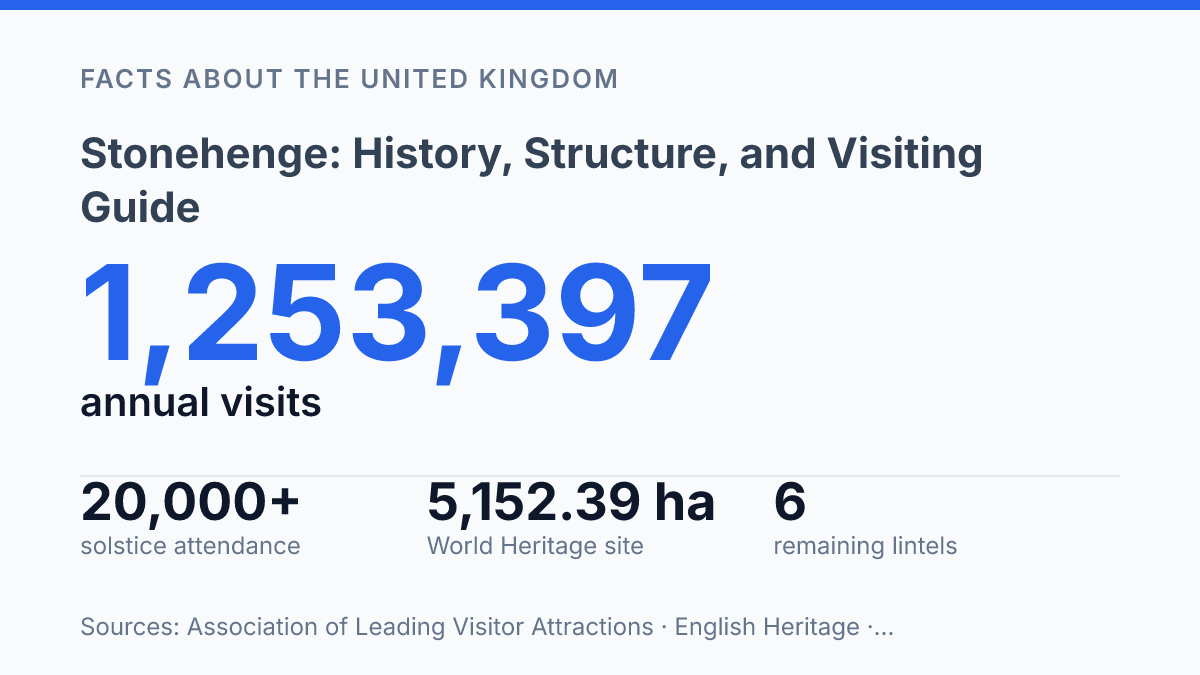
Stonehenge is best read at World Heritage scale: UNESCO’s “Stonehenge, Avebury and Associated Sites” covers 5,152.39 hectares, while the stone circle itself occupies only a small part of that protected area. That scale changes the question from how a single monument was built to how people organised construction, movement, ceremony, and access across Salisbury Plain and beyond for roughly 2,000 years, from about 3700 to 1600 BC. The engineering is still concrete enough to measure: an unbroken outer sarsen ring would have stood 30 m across, with lintels locked 4 m above the ground.
Yet the sources of the stones keep widening the story, from 25-ton sarsens likely brought about 32 km from West Woods to a 6-tonne Altar Stone linked in 2024 to northeast Scotland, more than 700 km away. The guide that follows explains the monument through location, construction evidence, management, access, and continuing significance.
What Stonehenge is and where it stands
Stonehenge is not an isolated circle on open ground but the best-known feature within a far larger prehistoric setting on Salisbury Plain. The monument stands in Wiltshire, England, about two miles, or 3 km, west of Amesbury, placing it within a chalk downland area rich in prehistoric remains rather than beside a modern town centre. Its current postal address is Salisbury SP4 7DE, United Kingdom.
Classified as a prehistoric megalithic structure, the site is defined by large standing stones and associated earthworks, but its identity is also tied to the surrounding ritual and funerary landscape. According to the UNESCO World Heritage Centre, current listing accessed, “Stonehenge, Avebury and Associated Sites” is a 5,152.39-hectare World Heritage property, first inscribed in 1986 with a minor boundary modification in 2008. That designation helps clarify why the monument is usually treated not only as an architectural landmark but as part of a connected prehistoric landscape.
The visual icon is compact and immediately recognisable, yet the protected setting is much broader than the stone arrangement itself. This distinction matters because the location on Salisbury Plain helps explain how the monument relates spatially to nearby prehistoric features, open grassland, and long views across the surrounding terrain. Before questions of assembly, access, or meaning can be assessed, the site is best placed first as a megalithic monument within a wider Wiltshire archaeological zone.
How the stones were assembled
A completed sarsen circle would have carried a 30-metre stone ring four metres above ground, locked together with carpentry-style joints rather than simply balanced blocks. The best-known part of the monument was the outer ring of vertical sarsen standing stones, with each upright typically around 13 feet (4.0 m) high, seven feet (2.1 m) wide, and about 25 tons. According to English Heritage, only six outer-circle lintels remain in place today, but the intended design appears to have been a continuous elevated ring rather than a loose arrangement of individual megaliths.
The horizontal lintel stones are the feature that most clearly separates the structure from many other prehistoric stone settings. Each lintel was shaped to sit on top of the uprights using mortise and tenon joints, a method more familiar from timber construction than from megalithic architecture and described by English Heritage as unique among contemporary monuments. The stones also used tongue-and-groove joints between adjoining lintels, which helped align the ring and maintain its circular form.
Such precision implies careful planning at several stages: quarrying or selecting large stones, shaping their contact points, raising the uprights, and positioning the lintels high enough for the joints to engage. Most of the large sarsens are thought by English Heritage to have come from West Woods, with the source area roughly 20 miles, or 32 km, from the monument. Moving stones of that scale required organised labour and repeated handling, even before the most technically demanding lifting and fitting work began.
Recent geological research has made the wider assembly story more complex without turning it into certainty. A 2024 Nature study identified the Altar Stone as a six-tonne recumbent sandstone measuring 4.9 × 1.0 × 0.5 m and matched it to Old Red Sandstone of the Orcadian Basin in northeast Scotland, more than 700 km away. The engineering visible in the standing sarsens is therefore only part of the construction problem: the monument shows highly controlled design, while the full tools, labour systems, and transport methods behind that control remain only partly understood.
Ownership, management, and site access
Ownership of the monument rests not with a private estate or commercial venue, but with The Crown. That status matters because access is framed around preservation duties as much as public admission: the stones and surrounding archaeological ground are treated as a protected heritage asset, with visitor movement, event arrangements, filming, research access, and close-approach permissions controlled to reduce wear and disturbance.
Why the monument still matters
A monument built before written records has become one of Britain’s clearest symbols of deep time precisely because its original function remains unresolved. The site is among Britain’s best-known prehistoric monuments, but its fame does not rest on a simple explanation. Competing interpretations have linked it to ceremony, burial, seasonal observation, ancestry, and political or social gathering, yet the evidence does not reduce neatly to a single purpose.
The World Heritage Site Management Plan places the wider archaeological setting within roughly 2,000 years of monument-building and use, from about 3700 to 1600 BC. That long chronology matters because it shifts attention away from a single construction episode and toward repeated activity across generations. The monument is therefore not only an object to be admired, but a reference point for studying how prehistoric communities organised labour, marked place, and created meaning without written records.
Archaeological interest remains active because each method can alter the questions being asked. Field survey, excavation, radiocarbon dating, geophysical prospection, and geological analysis have all helped refine understanding of sequence, material movement, surrounding earthworks, and human activity in the wider area. Public interpretation depends on the same discipline: the strongest explanations separate observed evidence from plausible reconstruction, allowing uncertainty to remain visible rather than smoothing it into a fixed story.
Its cultural recognition is also inseparable from scale. The massing of the stones, the planned geometry, and the openness of the surrounding setting create an image that is immediately legible, even to people with little knowledge of prehistory.
That visual force helps explain why the monument has become a shorthand for ancient Britain, national heritage, and archaeological mystery. Its significance endures because it combines physical ambition with interpretive restraint: it is large enough to command attention, old enough to anchor British prehistory, and ambiguous enough to keep scholarly and public discussion alive.
What the wider setting changes about the monument
New evidence is likely to make the monument more complex rather than simpler. Isotope studies, sediment analysis, and stone provenancing have already turned transport from a general mystery into a set of testable routes, sources, and human choices. That has a practical effect: the site cannot be understood only from the central circle or treated only as a photo stop.
Its value depends on protected ground, controlled access, archaeological context, and the continued accommodation of public rituals such as the summer solstice. The most useful future visits will be those that treat the stones as the visible centre of a larger system, where a path, bank, burial mound, or missing lintel can carry as much evidence as the famous trilithons.
Frequently Asked Questions
Q: Where is Stonehenge located?
A: Stonehenge stands on Salisbury Plain in Wiltshire, England, about two miles (3 km) west of Amesbury. Its postal address is Salisbury SP4 7DE, United Kingdom. The site is managed as a historic monument on Crown land.
Q: How old is Stonehenge?
A: Stonehenge is a prehistoric monument, built in stages over a long period rather than at a single moment. Archaeological evidence places its construction in the Neolithic and early Bronze Age, which is why it is treated as one of Britain’s most significant ancient sites.
Q: What is Stonehenge made of?
A: The monument is built from large sarsen stones arranged in an outer ring and topped by horizontal lintels. The standing stones are around 13 feet (4.0 m) high, seven feet (2.1 m) wide, and weigh about 25 tons each. Their fitted joints are unusual for prehistoric monuments of this type.
Q: What makes the stone joints at Stonehenge unusual?
A: The lintels are secured with mortise and tenon joints, a woodworking technique adapted to stone. That feature is unique among contemporary monuments and shows a high level of planning and stone-working skill. It also helps explain why the monument is structurally distinctive among prehistoric sites.
Q: How can visitors contact Stonehenge?
A: The site can be reached at +44 370 333 1181. Visitors should use the official contact details for opening times, ticket information, and access arrangements. The address is Salisbury SP4 7DE, United Kingdom.