
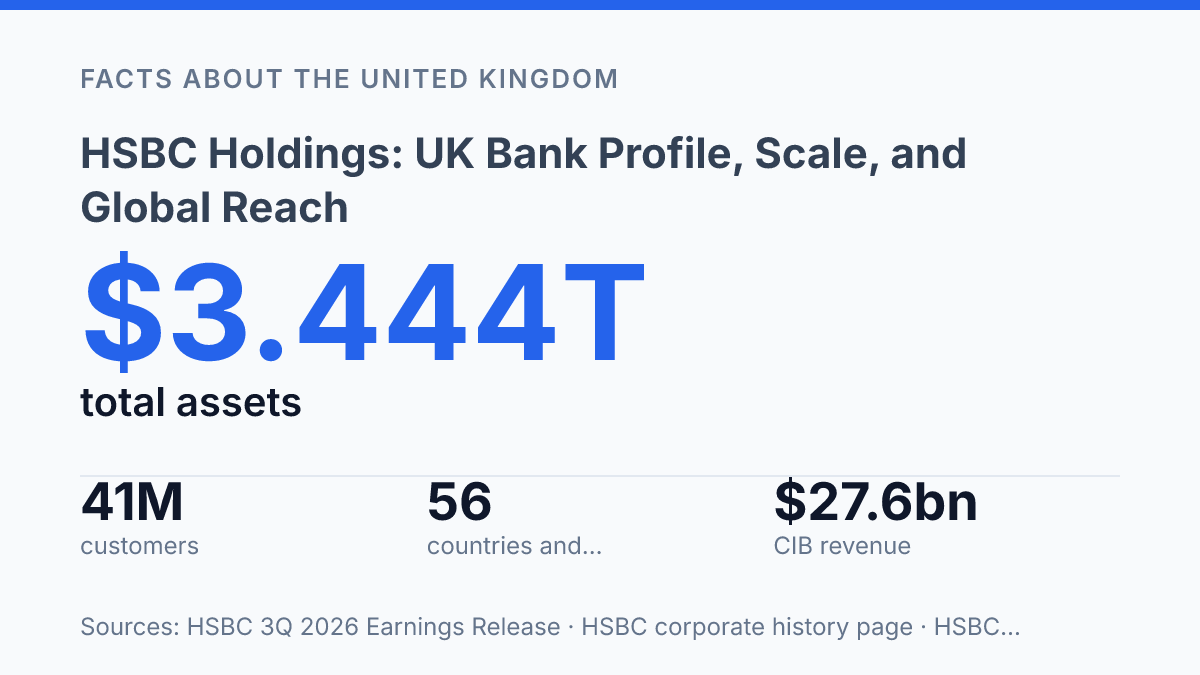
HSBC Holdings reported $3.444821 trillion in total assets at 30 September 2026, placing a Hong Kong-founded institution among Europe’s largest banks by balance-sheet scale. The scale is easier to understand when set against its origins: Thomas Sutherland raised HKD5 million in founding capital, opened the bank in Hong Kong on 3 March 1865, opened in Shanghai a month later, and established a London office by July of the same year. That early pattern helps explain why HSBC is not simply a UK bank with overseas branches, nor only an Asian bank with a London listing.
Its modern profile was shaped by the 1991 group restructuring, the 1992 Midland Bank acquisition, and a business model now weighted toward Asia, wealth, corporate banking, and cross-border clients. The article examines how those pieces fit together: history, legal base, size, organisation, and market role.
How HSBC was founded in Hong Kong and moved into UK banking
HSBC’s first London office opened only four months after its Hong Kong launch, so its British connection began long before it became a London-controlled banking group. The bank was founded on March 3, 1865 in Hong Kong by Thomas Sutherland, a Scottish shipping executive whose commercial focus reflected the financing needs of merchants moving goods between China, India, Europe, and other trading markets.
According to HSBC, 2026, history timeline, Sutherland raised HKD5 million in founding capital, issued 20,000 shares, opened in Hong Kong on 3 March 1865, opened in Shanghai one month later, and opened a London office in July 1865. That sequence shows that the institution was not conceived as a purely local deposit bank. Its early purpose was to provide credit, payments, and trade finance for firms operating across long-distance commercial routes, especially those linked to Hong Kong’s position as a trading port.
The later move into UK banking gave this Asian-founded institution a different corporate centre of gravity. HSBC Holdings plc was formed in 1991, and the following year the group acquired full ownership of Midland Bank, a major British clearing bank. After that transaction, the group’s global headquarters moved to London, making the United Kingdom its legal and managerial base while preserving the commercial identity built around Hong Kong and wider East Asian trade.
This history explains the bank’s dual profile better than a simple national label can. Its origin lies in Hong Kong’s nineteenth-century trade finance economy, but its modern holding-company structure and strategic control sit in the UK. The result is a British banking group whose brand, client relationships, and institutional memory remain closely associated with Asia.
Where HSBC is based and how it is run today
The group is legally anchored at 8 Canada Square in London, United Kingdom, even though its customer base and revenue are spread far beyond Britain. UK Companies House lists HSBC Holdings plc under company number 00617987, with the registered office at that Canary Wharf address and incorporation dated 1 January 1959. That legal domicile places the parent company inside the UK corporate and regulatory system, while the operating profile remains that of a multinational banking group rather than a chiefly domestic lender.
HSBC Holdings plc is best understood as a British universal bank and financial services group. In this context, “universal” means the group spans major banking activities rather than operating as a narrow specialist: retail banking, wealth, commercial banking, payments, markets, transaction banking, and institutional services all sit within the wider organization.
Since 2025, HSBC has reported through four main businesses, according to its Annual Report and Accounts: Hong Kong, the UK, International Wealth and Premier Banking, and Corporate and Institutional Banking. The structure shows how management separates domestic UK activity from Hong Kong, wealth, and large corporate or institutional operations.
Current executive leadership is led by Chief Executive Officer Georges Elhedery. His role represents group-level executive control rather than management of a single national bank: the CEO is responsible for implementing board-approved strategy, directing senior management, allocating resources across business lines, and steering performance across markets. This matters because the parent company’s UK base does not make its leadership agenda purely British; it requires coordination across legal entities, regulators, currencies, and customer segments.
The geographic balance reinforces that distinction. HSBC says it serves around 41 million personal, wealth, and corporate customers in 56 countries and territories, a scale that makes the London headquarters a corporate control centre rather than a proxy for where most activity occurs. The result is a bank that is firmly part of the UK financial system at the holding-company level, while still retaining a business model shaped by cross-border banking and significant activity outside the UK.
How large is HSBC compared with other European banks?
S&P Global Market Intelligence placed HSBC second among European banks by assets in its April 2026 ranking, giving the group a scale position that few regional peers can match. The report listed assets of $3.212 trillion as of 31 December 2025, a balance-sheet figure that captures the total stock of loans, securities, cash, trading assets, and other financial positions held by the bank at that date.
That ranking is significant because asset size is one of the clearest measures of a bank’s capacity and market reach. A multi-trillion-dollar balance sheet allows a bank to support large corporate clients, absorb substantial deposit flows, participate in capital markets, and operate across multiple banking lines at once. It also means that movements in credit quality, interest rates, liquidity conditions, or regulatory capital requirements can have effects at a very large absolute scale.
The comparison should be read carefully, because assets do not measure every dimension of strength. A bank can rank highly by assets while differing from peers in profitability, risk-weighted assets, business mix, geographic exposure, or capital returns. In this context, the European ranking indicates balance-sheet breadth rather than a complete judgment on performance.
Later company reporting reinforces the same scale picture. HSBC’s third-quarter 2026 earnings release reported total assets of $3.444821 trillion at 30 September 2026, alongside $1.836801 trillion in customer accounts and $1.029858 trillion in net loans and advances to customers. Those figures show that the group’s asset base is not only large in ranking terms but also supported by very substantial customer funding and lending activity.
Size brings both capacity and complexity. A bank operating at this level can finance large clients and maintain diversified sources of income, but it must also manage capital allocation, liquidity, regulatory scrutiny, and portfolio risk across a wider set of products and markets than smaller domestic lenders.
What HSBC’s global footprint means for customers and markets
Asia accounted for $95bn of the $105bn in net new wealth money HSBC attracted in the first nine months of 2026, according to its 3Q 2026 earnings release. That concentration helps explain why East Asia remains central to the group’s business model: the region is not only part of the bank’s history, but also a current source of client growth, wealth balances, trade flows, and corporate banking demand.
The bank’s multinational presence gives it a practical role in moving money and information between regions rather than serving only as a domestic lender. Its network across Europe, Asia, North America, the Middle East, and other major markets supports cross-border payments, cash management, foreign exchange, trade finance, and institutional banking for companies that buy, sell, borrow, and invest across more than one jurisdiction. For internationally active customers, the value lies in having banking relationships that can connect local accounts, regional treasury needs, and global counterparties through one group.
Service reach also shows up in customer support arrangements. The published North American customer service number, 1 (888) 310-4722, is a small but concrete sign that the group’s operating footprint extends beyond its Asian and European centers into large consumer and commercial markets elsewhere. This kind of coverage matters most for customers whose banking needs are not confined to one country, such as expatriates, internationally mobile wealth clients, importers, exporters, and firms with suppliers or subsidiaries overseas.
Scale across regions also brings exposure to uneven economic and regulatory conditions. A bank active in several major markets must manage different capital rules, conduct standards, sanctions expectations, data requirements, interest-rate cycles, and credit conditions.
The same footprint that supports global trade and cross-border banking can therefore transmit regional weakness or policy change into group-level planning. HSBC’s strategic emphasis on East Asia reflects this balance: the region offers growth in wealth and corporate activity, but it also requires close management of local market cycles and regulatory expectations.
Where scale becomes a strategic constraint
A bank of this size is not defined only by where its headquarters sits. Its practical significance lies in the way capital, deposits, credit, and wealth-management flows pass through the same group across regions with different economic cycles and regulatory priorities. The 2026 figures point to that complexity: wealth balances of $1.6 trillion and $105 billion of net new money in the first nine months, with $95 billion booked in Asia, show where growth is being concentrated.
For customers and markets, the benefit is reach; the qualification is exposure to more than one jurisdiction, currency system, and policy environment. HSBC’s next phase will depend less on geographic breadth alone than on how effectively that breadth is allocated.
Frequently Asked Questions
Q: What does HSBC Holdings do as a bank?
A: HSBC Holdings plc is a British universal bank and financial services group that provides retail, commercial, and wealth-related services across multiple markets. Its structure reflects a broad international banking model rather than a single-country retail focus.
Q: Where is HSBC Holdings headquartered?
A: HSBC Holdings is headquartered in London, United Kingdom. The group also has historical and business links to East Asia, which remain central to its multinational profile.
Q: How large is HSBC Holdings by assets?
A: According to S&P Global‘s April 2026 report, HSBC is Europe’s second-largest bank by assets. The bank reported $3.212 trillion in assets, which places it among the largest financial institutions in the region.
Q: When was HSBC Holdings founded?
A: HSBC Holdings was founded on March 3, 1865, in Hong Kong. Its origin in a major trading center helps explain the group’s long-running international orientation.
Q: Who leads HSBC Holdings and how can customer service be reached?
A: The chief executive is Georges Elhedery, who leads the group from London. Customer service can be reached at 1 (888) 310-4722.