
Barclays PLC links two unusually concrete markers of British banking: a Lombard Street partnership recorded in 1690 and the first operational cash machine, installed at Enfield on 27 June 1967. That range helps explain why the bank is best understood through both institutional continuity and repeated reinvention. Its growth was not a simple line from old private bank to modern multinational; it was shaped by consolidation, legal restructuring, acquisitions, technology, and shifts in where banking profits and risks sit.
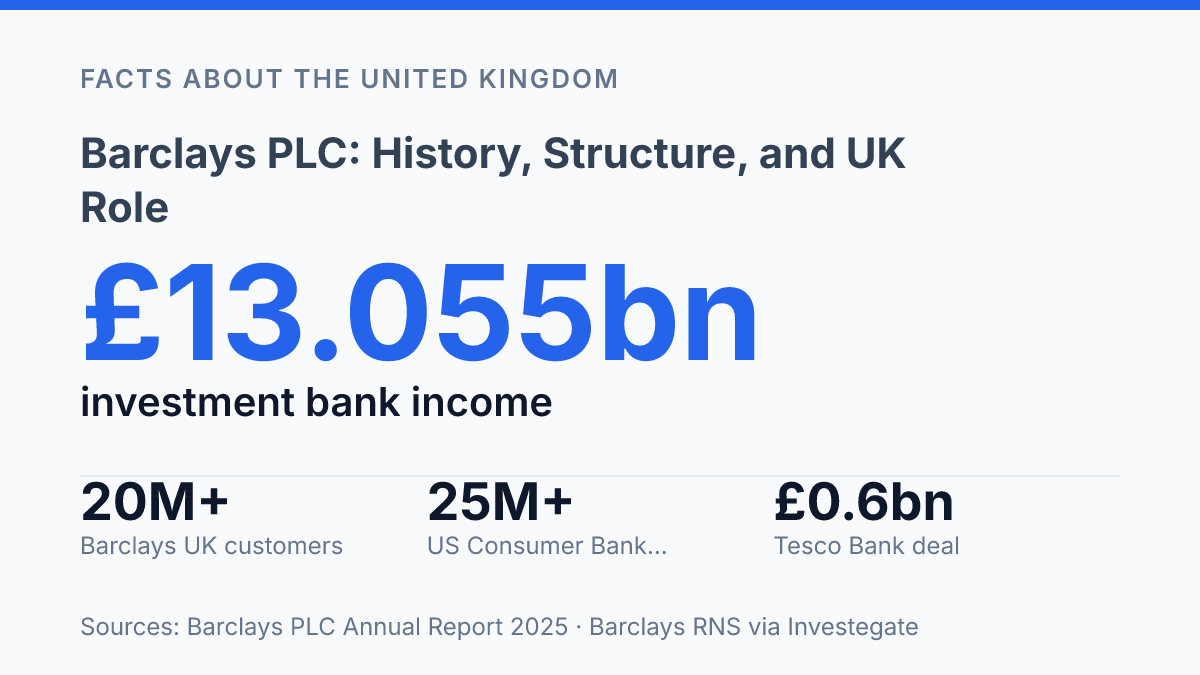
By 1920, after the 1896 formation of Barclay and Company Limited and a wave of takeovers, the group ranked third among Britain’s Big Five clearing banks. In 2025, its structure spanned five operating divisions, with the Investment Bank generating £13.055bn of income and accounting for 55% of group risk-weighted assets.
From a London goldsmith bank to a national lender
Barclays’ national reach began not with a single dramatic expansion but with more than two centuries of accumulated partnerships, family banking ties, and later consolidation. The starting point was a Quaker goldsmith-banking business established in the City of London in 1690 by John Freame and Thomas Gould, at a time when goldsmiths were among the private operators providing deposit, lending, and payment services before modern joint-stock banking became dominant. This origin matters because the firm’s early identity was rooted in relationship banking rather than in a large corporate structure.
The Barclay name entered the business when James Barclay became a partner in 1736, linking the firm to a family name that would outlast the original partnership. According to Archives Hub / Barclays Group Archives, the bank traces its roots to John Freame and Thomas Gould’s Lombard Street business in 1690, James Barclay’s entry into the partnership in 1736, and the 1896 formation of Barclay and Company Limited through the joining of 19 smaller banks. The continuity of the name masks a changing legal and commercial form: what began as a private City partnership gradually became part of a wider banking network.
The decisive structural shift came in 1896, when twelve banks united as Barclays and Co., including Goslings Bank, Backhouse’s Bank, and Gurney, Peckover and Company. That union was not merely a rebranding exercise; it brought together London and provincial banking interests at a point when scale, branch coverage, and clearing capacity were becoming more important to competition.
Over the next generation, further takeovers helped turn the enlarged firm into a national lender, and by 1920 it ranked third among Britain’s Big Five clearing banks. Barclays’ emergence as a household banking name was therefore the product of consolidation layered on top of an older private-banking lineage, rather than the result of one sudden leap from local firm to national institution.
How the group is organised today
The Investment Bank accounted for 55% of the group’s risk-weighted assets in 2025, even though the same group also contained large UK and US consumer franchises. Barclays PLC is a British multinational universal bank headquartered in London, England, and its current structure is designed to separate retail, corporate, wealth, and market-facing activities rather than present the institution as a single-line bank.
According to the group’s 2025 annual report, published in 2026, the company operated through five divisions: the UK Consumer Bank, UK Corporate Bank, Private Bank and Wealth Management, Investment Bank, and the US Consumer Bank. The UK Consumer Bank covers domestic personal banking and related consumer finance, while the UK Corporate Bank serves business and institutional clients in the home market. Private Bank and Wealth Management sits between those franchises and capital markets, focusing on clients whose needs include investment services, advice, and wealth administration.
The Investment Bank is the most capital-intensive part of the structure, generating £13.055bn of income and accounting for the majority share of the group’s £357bn risk-weighted assets, according to the same annual report. That allocation shows why the group cannot be understood only through its consumer banking brand: a large share of its balance-sheet risk and earnings capacity is tied to wholesale banking, advisory, trading, and financing activities.
A separate US Consumer Bank gives the group a second major retail market outside the United Kingdom. The annual report said Barclays UK served more than 20 million customers in 2025, while the US Consumer Bank had more than 25 million customers and partnerships with 20 major U.S. brands. This broad universal-bank model can spread income across several business lines, but it also links performance to different credit cycles, interest-rate conditions, customer behaviours, and regulatory systems in the UK and United States.
Major acquisitions and expansion milestones
The 2008 purchase of Lehman Brothers’ North American operations did more than add assets; it materially changed Barclays’ position in U.S. investment banking at a moment when competitors were retreating. According to a Barclays SEC filing, the transaction covered North American investment banking and capital markets operations, including about 10,000 employees, £40bn / $72bn of trading assets and £38bn / $68bn of liabilities, with combined consideration of about £1.0bn / $1.75bn. That made the 2008 deal a major transatlantic expansion step, giving Barclays greater scale in equities, fixed income, advisory work and institutional client coverage.
Earlier acquisitions had served a different but related purpose: widening the bank’s reach through established businesses rather than organic branch-by-branch growth alone. The purchase of London, Provincial and South Western Bank in 1918 and British Linen Bank in 1919 marked an early post-consolidation phase of expansion, adding existing customer relationships, staff expertise and regional presence. These deals helped convert a London-centred banking group into a broader institution with deeper coverage across the United Kingdom.
Later transactions show how acquisitions were used to enter or strengthen specific product markets. Mercantile Credit, acquired in 1975, expanded the group’s presence in consumer and commercial finance. The Woolwich acquisition in 2000 strengthened its position in mortgages and retail financial services, reflecting the value of buying a recognised lender with an established customer base rather than building equivalent scale from scratch.
The purchase of Lehman Brothers’ North American operations carried the greatest strategic significance among these named deals because it accelerated Barclays’ investment banking ambitions outside the UK. The same feature that makes acquisition attractive, rapid access to markets and capabilities, also creates integration demands. Staff retention, technology alignment, risk controls and balance-sheet management become central to whether the acquired business strengthens the group or requires restructuring.
Why Barclays matters in UK banking history
A paper voucher and a four-digit PIN made Barclays part of everyday technology history before bank cards became ordinary. In 1967, the bank deployed the world’s first cash dispenser, inaugurated at its Enfield branch on 27 June, according to Historic England. The machine dispensed a £10 note when a customer inserted a specially prepared paper voucher, an early model of automated access that linked branch banking to self-service infrastructure.
That innovation matters because it made banking modernization visible to the public. Many changes in finance occur inside balance sheets, clearing systems, or regulatory structures, but the cash dispenser altered the customer’s physical relationship with the bank. It showed how a large institution could turn scale into operational change: a branch network was no longer only a set of counters staffed during fixed hours, but a platform through which automated services could be introduced and normalized.
Barclays’ wider historical importance rests on that combination of continuity and adaptation. Its development offers a compact reference point for several shifts in British banking: the movement from private partnership banking to incorporated banking, the rise of national branch networks, the broadening of retail and corporate services, and the later emergence of universal banking. The company’s record is not just a sequence of corporate milestones; it reflects how British banking institutions became larger, more complex, and more technologically mediated over time.
The cash-machine milestone should not be read as proof of permanent competitive advantage. A technology first can have a strong place in public memory while later performance depends on strategy, regulation, risk management, capital strength, and market conditions. Its significance is narrower but still substantial: it captures why Barclays remains a frequent reference point in UK banking history, not only as an old institution, but as one associated with operational modernization at moments when the form of everyday banking was changing.
What scale now requires from the bank
The bank’s history suggests that scale has rarely been static; it has been rebuilt through legal form, branch expansion, technology, crisis-era acquisitions, and consumer-finance partnerships. The next measure of Barclays will be less about whether it remains large and more about how that scale is allocated between domestic banking, global markets, and overseas consumer lending.
The 2024 Tesco Bank acquisition and the planned 2025 Best Egg deal point to a group still using acquisition to shape its customer base, not only its balance sheet. For UK banking history, that makes Barclays a useful case study in how national institutions adapt without becoming purely domestic institutions.
Frequently Asked Questions
Q: When was Barclays founded?
A: Barclays traces its origins to a goldsmith banking business established in the City of London in 1690 by Quakers John Freame and Thomas Gould. James Barclay became a partner in 1736, and the business later developed into Barclays and Co. in 1896. That date is usually treated as the start of the modern bank.
Q: What are the main divisions of Barclays?
A: Barclays operates through five divisions: the UK Consumer Bank, UK Corporate Bank, Private Bank and Wealth Management, the Investment Bank, and the US Consumer Bank. This structure separates retail, business, wealth, and investment services across different markets. It also reflects the bank’s role as a universal bank rather than a single-service lender.
Q: Where is Barclays headquartered?
A: Barclays PLC is headquartered in London, England. Its roots are also tied to the City of London, where the original banking business began in 1690. That location has remained central to the group’s identity and its position in UK financial services.
Q: How did Barclays become one of the UK’s major banks?
A: A major step came in 1896, when twelve banks in London and the English provinces united under the name Barclays and Co. Over time, the group expanded through acquisitions and branch growth, becoming a nationwide bank. This consolidation helped Barclays build scale across personal, commercial, and investment banking.
Q: What are some important milestones in Barclays’ history?
A: Barclays introduced the world’s first cash dispenser in 1967, which marked a significant change in everyday banking access. Other major acquisitions included London, Provincial and South Western Bank in 1918, British Linen Bank in 1919, Mercantile Credit in 1975, the Woolwich in 2000, and the North American operations of Lehman Brothers in 2008. These moves show how the bank has expanded its reach over time.