Glasgow still moves heavy things: in 2024, King George V Dock was due to handle more than 1,000 wind-turbine components, a clean-energy cargo that ties the Clyde to the next industrial age. The old port story isn’t sealed behind museum glass.
It still has cranes, freight. A job to do.
That tension makes the city worth reading closely. Victorian streets carry soot, ambition, and repair in the same stone. Mackintosh details sharpen doorways and tea rooms.
The arts scene is not nostalgia with better lighting. You’ll see how shipyards, listed buildings, music rooms, museums, and universities keep feeding each other. In my honest opinion, that’s the real character here: a city that refuses to choose between hard industry and high culture.
From Clyde port to industrial power
By the early 20th century, the Clyde was tied to 60% of Britain’s shipbuilding output, a figure that explains why the river still feels like the city’s spine rather than its edge.
Glasgow grew by facing west. The River Clyde carried goods, money, workers, and ambition between Scotland’s western Lowlands and the Atlantic world. That route made the port useful first, then powerful.
The shift became visible in the 1770s, when tobacco fortunes and merchant capital began changing both the economy and the streets. New warehouses, counting houses, and planned commercial spaces followed the money.
The city did not just expand. It started to perform wealth in stone.
That pride had a hard underside. Atlantic trade depended on systems of exploitation, and later industrial growth depended on punishing labor in yards, foundries, sheds, and docks. In my view, you can’t read the city honestly if you admire the grand façades but ignore the hands that paid for them.
Shipbuilding turned the Clyde from a trading corridor into an industrial machine. Sir George Young helped drive the growth of the Clyde shipyards, and firms along the river built vessels for empire, war, migration, and commerce. The result was not a neat port district. It was a whole urban economy shaped by metal, noise, skill, and risk.
The river’s industrial role didn’t vanish when heavy shipbuilding declined. King George V Dock in Glasgow was due to handle more than 1,000 wind-turbine components weighing over 60,000 tonnes in 2024, and since 2005 it had handled components for over 1,200 turbines, representing more than 35% of Scotland’s installed wind capacity, according to Peel Ports.
That modern cargo is different. The logic is familiar: the Clyde still moves the hardware of national change.
This is why the city’s layout feels so practical. Streets, bridges, quays, and civic buildings all point back to the same fact. The port made the city rich, but industry made it large, dense, and deeply marked by class.
Victorian streets and art nouveau details
The centre rewards anyone who looks above eye level: carved cornices, steep gables, iron balconies, stained glass, and shopfront curves all compete for attention within a few blocks.
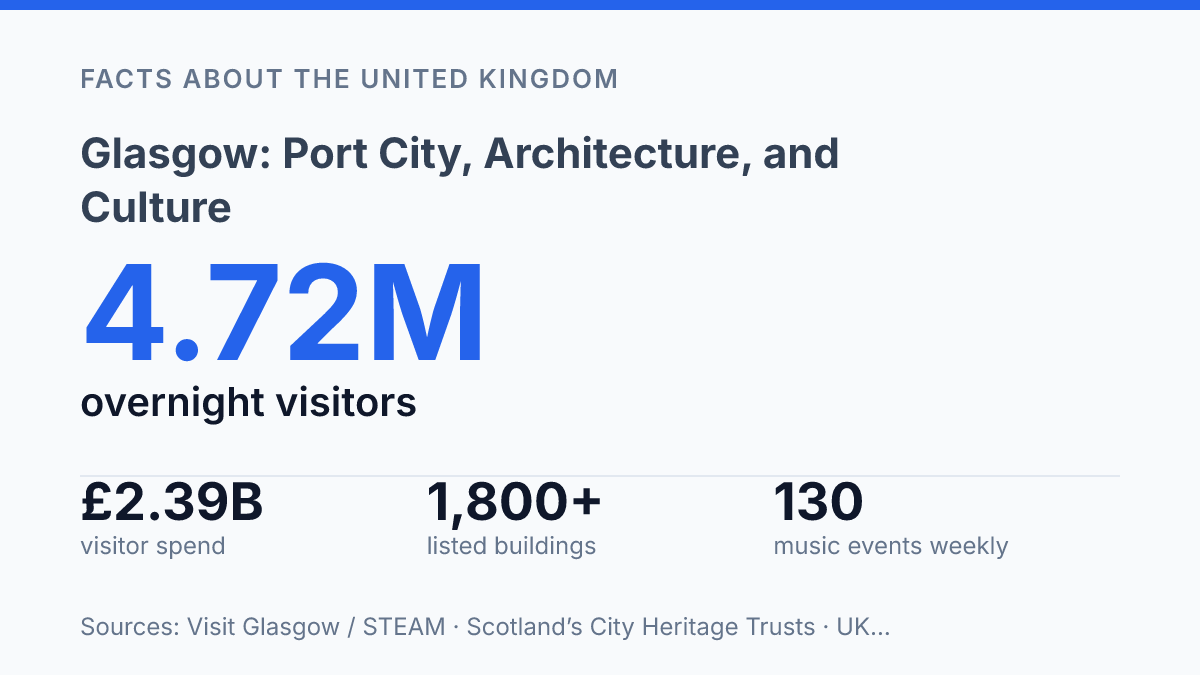
In the 1890s, many of the city’s key civic and commercial buildings rose during its wealthiest era. According to Scotland’s City Heritage Trusts report for 2024/25, the city now has more than 1,800 listed building entries and 25 conservation areas.
This isn’t just a handful of showpieces. It’s a dense urban record.
City Chambers makes the clearest statement of power. Its staircases, mosaics, and ceremonial rooms turn local government into theatre. That theatre had a purpose.
The architecture looks stable and generous. It also projected status during a period of deep social inequality.
Across the centre, Victorian sandstone gives the streets their weight. Gothic details add vertical drama, especially on public buildings and churches, while art nouveau touches soften the edges with plant forms, elongated lines, and patterned metalwork. Kelvingrove Art Gallery and Museum brings that mix into one highly visible landmark, with red sandstone massing that feels civic without being cold.
Charles Rennie Mackintosh sharpened this identity into something less predictable. Through the Glasgow Style, he and his circle blended art nouveau, Scottish baronial hints, Japanese influence, and severe modern geometry. The School of Art remains the essential reference point, not just as a building but as a design argument about light, craft, and restraint.
The Willow Tea Rooms show the same intelligence at a smaller scale. Mackintosh treated a commercial interior as total design, from furniture and wall panels to rhythm and atmosphere. In my honest opinion, that matters because it proves the city’s architecture isn’t only about grand façades. Its best details often work at the scale of a chair, a door handle, or a painted line.
Why the city leads Scotland’s arts scene
One Scottish city concentrates 4 of Scotland’s 5 national performing arts companies, according to city council culture data. That explains why its creative weight feels larger than its population. Scottish Opera, Scottish Ballet.
The National Theatre of Scotland give the city national authority. They also give artists a ladder. You can train, perform, collaborate, and stay.
The public pivot arrived in 1990, when the city was named European City of Culture. That year mattered because it changed the story outsiders told about the place. Heavy industry no longer had to be the only frame.
But the title didn’t create the culture from scratch. It made visible what local audiences already knew.
A sharper art-world signal comes through Glasgow International, the contemporary visual art festival that turns galleries, studios, and temporary spaces into a citywide argument about what art can be. It doesn’t behave like a polite showcase. The best work here often feels raw, political, funny, or stubbornly local. In my humble opinion, that edge is exactly why the city’s arts scene keeps its authority.
Live music gives the same point a louder pulse. The UK National Commission for UNESCO says the city hosts around 130 music events a week, with more than 500,000 people attending gigs each year. It became the UK’s first UNESCO City of Music in 2008.
Those numbers aren’t just tourism gloss. They mean musicians can find rooms, crowds, promoters, and repeat listeners.
The Royal Concert Hall gives the scene scale and ceremony. The Barrowland Ballroom gives it mythology.
Its sprung floor, neon sign, and fierce audiences have turned ordinary tour dates into rites of passage. That’s the tension at the heart of the city’s cultural power: it excels at opera, ballet, theatre, and major festivals, but its strongest creative energy still rises from clubs, small venues, rehearsal rooms, and working-class crowds who know when something is real.
Museums, universities, and what visitors notice first
A single walk from the University of Glasgow down to the Kelvingrove area can move from medieval scholarship to Salvador Dalí in less than 15 minutes. Founded in 1451, the university gives the West End its academic weight.
It doesn’t feel sealed off from the city around it. Students, tourists, museum-goers, and locals all share the same cafés, parks, and steep sandstone streets.
Kelvingrove Art Gallery and Museum turns that mix into a public habit. Over 1 million people visit it each year, a scale that makes it more than a sightseeing stop. It functions like a shared civic room, where school groups, first-time visitors, and repeat locals move through art, natural history, arms, armour, and oddities without the pressure of a ticket price.
The wider museum network keeps that public-facing character intact. The Riverside Museum gives transport design a dramatic riverfront home.
The People’s Palace anchors social history through everyday lives rather than grand names. According to the city’s 2024/25 cultural services annual review, local museums recorded nearly 4 million visits, which shows how deeply this model works.
Free entry matters here. It changes the mood of a museum visit from “special occasion” to “I’ll pop in for half an hour.” That sounds small.
It shapes how people use culture. You don’t have to plan the whole day around it.
People arrive for the famous institutions. The sharper appeal is the overlap.
A visitor can leave a gallery, cross into a student quarter, eat cheaply, then find late-night noise a few streets away. In my view, the city stands out because it doesn’t separate learning, museums, and nightlife into neat boxes. It lets them rub against each other in public.
What the Clyde city asks you to notice next
Treat the city less like a checklist and more like a working system. The same place that drew 4.72 million overnight visitors in 2024 still asks you to slow down at a cornice, a dock gate, or a rehearsal-room stair. That is the tradeoff.
The next decade will test whether culture can keep its edge as visitor demand rises. Charles Rennie Mackintosh gives the city an exportable design language; 2008, when it became the UK’s first UNESCO City of Music, gave it a global music label. Labels help.
They can flatten a place. In my humble opinion, go looking for the pressure behind the polish. The most honest version of the city is still half-built, half-preserved, and louder than expected.
Frequently Asked Questions
Q: Why is Glasgow known as a port city?
A: Glasgow grew on the River Clyde in Scotland’s western Lowlands. That river made trade possible on a huge scale. Shipbuilding turned that access into wealth during the 18th to 20th centuries. In my view, that economic base still shapes how the city feels today.
Q: What architecture is Glasgow famous for?
A: The city is known for Victorian and art nouveau buildings. That mix gives it real visual range. You get grand civic streets, then finer decorative details that reward a slower look… and that contrast is the point. It’s one of the clearest reasons people remember the city.
Q: How did shipbuilding shape Glasgow?
A: Shipbuilding brought money, jobs, and serious growth during the 18th–20th centuries. That prosperity left a deep mark on the city’s buildings and public spaces. The surprise is that the industrial story didn’t just build factories. It also helped shape the city’s cultural confidence.
Q: What cultural institutions are based in Glasgow?
A: Glasgow is home to the Scottish Opera, Scottish Ballet. The National Theatre of Scotland. That’s a strong national lineup for one city. It tells you how central Glasgow is to Scottish arts. Museums and live music add another layer. The big institutions carry real weight.
Q: Is Glasgow worth visiting for music and museums?
A: Yes, and not just because the names are impressive. The city has acclaimed museums and a thriving music scene. You can move from galleries to live shows without losing momentum. In my honest opinion, that mix is what makes the city feel alive rather than just historic.