
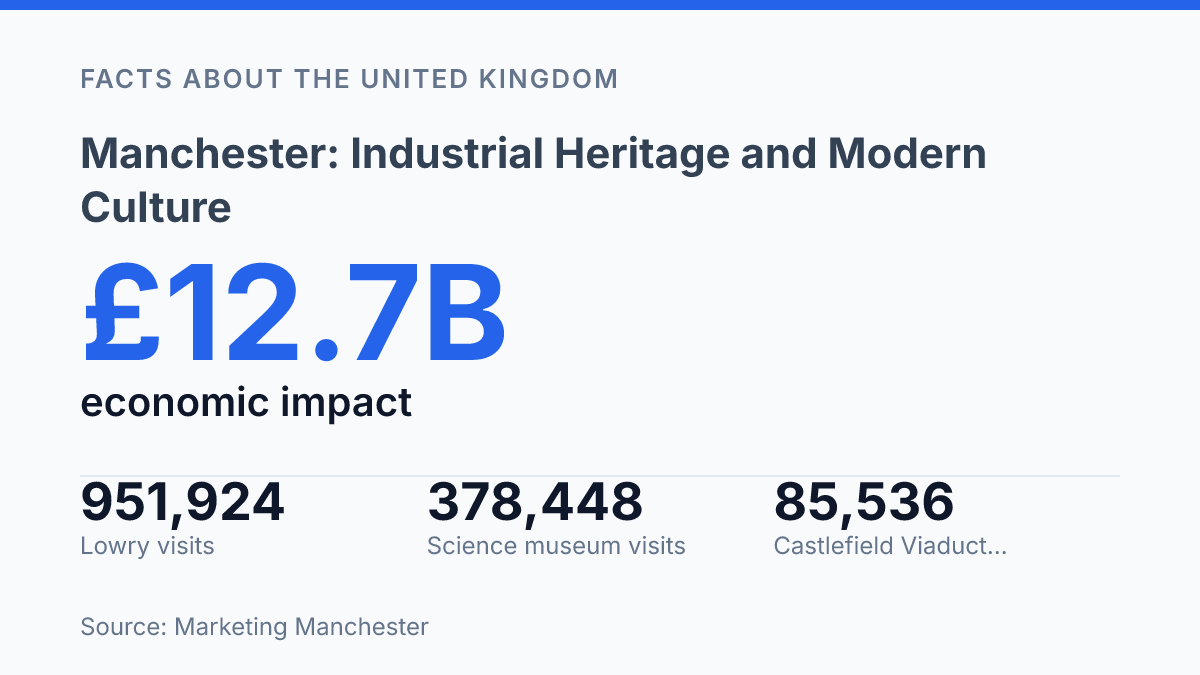
Manchester’s old mills, canals, and stations now sit inside a £12.7 billion visitor economy across the city-region. The story starts with coal getting cheaper overnight.
When the Duke of Bridgewater linked Worsley’s mines to the town in 1763, the price of coal was cut in half. That single piece of infrastructure changed what factories could afford, how goods moved, and why this place began to shape modern Britain.
The same tension still gives the city its edge. Visitors don’t come only for polished culture. In a 2023 leisure survey, 56% visited a museum or gallery, and overseas visitors pushed that figure to 87%.
They want evidence. Brick, iron, water, railway platforms, docklands made useful again.
In my honest opinion, the smartest thing the city did was stop treating its industrial past as a museum piece. Here, history has a job.
Why Manchester shaped modern Britain
A town nicknamed Cottonopolis helped teach Britain how an industrial city could make money from cloth, credit, and movement at the same time. Its cotton textile trade wasn’t just about mills. It depended on warehouses, brokers, banks, insurers, roads, rail links, and waterways that turned raw cotton into a national economic force.
It sits in northwest England and now stands as a major urban centre in Greater Manchester. That position gave it access to workers, ports, markets, and capital.
Geography did not guarantee success. It gave the city a hard commercial edge.
By the 19th century, mills and counting houses had made the city a symbol of industrial Britain. Cotton moved through its economy, but finance made the system scale.
Transport kept it moving. That mix mattered more than any single factory chimney.
That success came with a bill. Heavy industry brought smoke, dirty water, packed housing, and brutal working conditions. The same model that made the city rich also left problems that later generations had to clean up, redesign, and live with.
The present-day comparison is sharp. The old city sold textiles to the world.
The modern one sells knowledge, culture, professional services, research, and major events. Its universities, businesses, galleries, venues, and media economy now do some of the work once done by mills and warehouses.
Heritage still has economic weight, not just sentimental appeal. Tourism activity generated £12.7 billion of economic impact across the city-region in 2023, including £6.80 billion in the local authority area, and supported 122,900 FTE jobs, according to Marketing Manchester. In my view, the city matters because it turned industrial power into a civic habit: build, adapt, reuse, then argue over what comes next.
Castlefield and the canal network that built the city
Coal got so cheap after the canal arrived that the town’s fuel price was halved overnight, according to the Canal & River Trust. That one shift explains Castlefield better than any plaque can.
The preserved basins and towpaths don’t just look atmospheric. They show the supply chain that fed the textile boom.
The Bridgewater Canal changed what industry could cost. It carried coal from the Duke of Bridgewater’s Worsley mines, then helped move raw materials into the city and finished goods out again.
Cheaper fuel meant steam power became more practical. Faster movement meant mills and warehouses could work at a larger scale.
Castlefield conservation area makes that system visible in a way maps can’t. Its 18th-century canal network, wharves, locks, and waterside warehouses sit close together. You can read the place almost like a working diagram.
This wasn’t ornamental water. It was a freight machine.
By 1765, the canal had reached Castlefield Wharf, turning the district into one of the key receiving points for the goods that kept factories running. Cotton didn’t become an industrial force through machines alone.
It needed coal, timber, dyes, building materials, credit, labour, storage, and transport. The canals tied those moving parts together.
Here’s the twist: the waterways were built for hard commercial use, but now they anchor one of the city’s most readable heritage districts. People walk, cycle, sit by the water, and trace routes once used by boats carrying fuel and cargo. In my honest opinion, that contrast is what makes Castlefield so powerful: it turns infrastructure into public history without sanding off its working past.
The area also avoids the trap of making industrial heritage feel abstract. You don’t have to imagine the whole textile economy at once.
You can stand beside the canal edge and see why location, fuel, and movement mattered. The boom was built in brick, water, and towpath before it became a symbol of industrial Britain.
Museums and landmarks that bring the past to life
A moving steam engine teaches more in ten seconds than a wall text can in ten minutes. That’s the strength of the Museum of Science & Industry: it turns industrial history into noise, heat, scale, and motion, not just labels behind glass.
The site matters before you even reach the galleries. Its 1830 Station at Liverpool Road is the oldest surviving passenger railway station in the world, according to the Science and Industry Museum.
That single building shifts the story from factory floors to systems: railways, goods movement, engineering skill. The shrinking of distance.
Inside, the strongest exhibits connect invention to work. Visitors can see transport collections, steam-power displays, and early computing material that show how the city’s industrial force reached beyond cloth production.
The point isn’t simply that machines got bigger. It’s that manufacturing created demand for precision, power, data, speed, and repair.
That broader frame matters. Textile mills made the city famous. The museum shows the deeper engine underneath: engineers, mechanics, chemists, programmers, and railway workers all shaped what industry became. In my humble opinion, that’s where the museum earns its keep, because it refuses to reduce the place to cotton alone.
Popularity backs that up. The museum drew 378,448 visitors in 2024 even during major restoration, with not all buildings open, according to Marketing Manchester. For a heritage site under repair, that number says people still want direct contact with the physical evidence of industrial change.
There’s a catch, though. A museum can make old machinery feel vivid. It can also flatten the messier parts of industrial life: dangerous labour, polluted air, long hours, and unequal rewards.
That gap is part of the story. The machines are impressive. The human cost behind them should stay in the room too.
Salford Quays and Manchester’s cultural reset
A former cargo dock now pulls crowds on a scale many traditional attractions would envy: Lowry recorded 951,924 visits in 2024, according to the regional tourism agency. That figure matters.
It shows Salford Quays isn’t a side trip anymore. It has become one of the city-region’s clearest examples of cultural reuse at scale.
Salford Quays is a revived docklands area in Greater Manchester, but its polish can mislead you. The waterside paths, restaurants, theatres, and event spaces sit on land shaped by physical labour, freight handling, and maritime trade.
That contrast is the point. The place works because it doesn’t pretend the old dock estate was gentle.
Two anchors give the Quays its cultural weight. The Imperial War Museum North, designed by Daniel Libeskind, brings conflict and memory into a district once defined by movement of goods. Nearby, the Lowry cultural centre turns the area toward performance, exhibitions, family events, and evening audiences.
One building asks visitors to confront rupture. The other invites them to gather. Together, they make the waterfront feel purposeful rather than merely redeveloped.
The shift from working docks to visitor district wasn’t just cosmetic. Salford City Council reported 8.0 million visits in 2023, with £1.05 billion in economic impact and 10,100 full-time-equivalent jobs supported.
Those numbers point to a deeper change. Former industrial land now earns its keep through culture, hospitality, media, and public space.
Yet the Quays can feel almost too smooth. You can arrive for a show, eat by the water, take photos, and miss the harder story beneath your feet. In my view, the best reading of Salford Quays is not that industry disappeared here. It’s that the area learned to carry its industrial past in a different form.
The next chapter depends on reuse, not nostalgia
The next test is not whether the old structures can attract crowds. They already do. In 2024, Lowry drew 951,924 visits, proving that former docklands can compete with any traditional city-centre draw.
The harder question is what gets protected when growth speeds up. Restoration brings money.
It can sand down the awkward edges that made these places matter. Smoke, labour, risk, poverty, invention… they all belong in the story.
In my humble opinion, the best heritage cities don’t tidy the past into comfort. They let it argue with the present.
If you visit well, you won’t just look at what survived. You’ll ask who paid for it, who rebuilt it, and what the city chooses to keep next.
Frequently Asked Questions
Q: What is Manchester best known for historically?
A: Manchester is best known for its role in the textile boom of the 18th and 19th centuries. The Castlefield conservation area still shows that past through its canal system. That matters because you can see the city’s industrial rise in the streets themselves. In my view, that’s the part people should explore first.
Q: Can you still see Manchester’s industrial heritage today?
A: Yes. You don’t have to look hard. Castlefield keeps the old canal network in view. The Museum of Science & Industry turns that history into something you can actually walk through. The contrast is sharp… old infrastructure sits beside a modern city that never stopped moving.
Q: What should I visit in Manchester for modern culture?
A: Salford Quays is the clear pick. The old dockyards now hold the Daniel Libeskind-designed Imperial War Museum North and the Lowry cultural centre. The area mixes architecture, art, and memory in one stop. In my honest opinion, it’s one of the city’s strongest examples of reinvention.
Q: Is Manchester good for a short city break?
A: Yes, because the key sights are close enough to connect in one trip. You can pair Castlefield with the Museum of Science & Industry, then head to Salford Quays for a different side of the city. That mix gives you history and culture without wasting time crossing the city.
Q: Why does Manchester matter in English history?
A: Manchester mattered because it helped drive Britain’s textile economy. That influence still shapes how the city is seen today. The old canals and docklands tell that story clearly. The modern cultural venues show the city didn’t freeze in the past. 18th-century Manchester canal system