
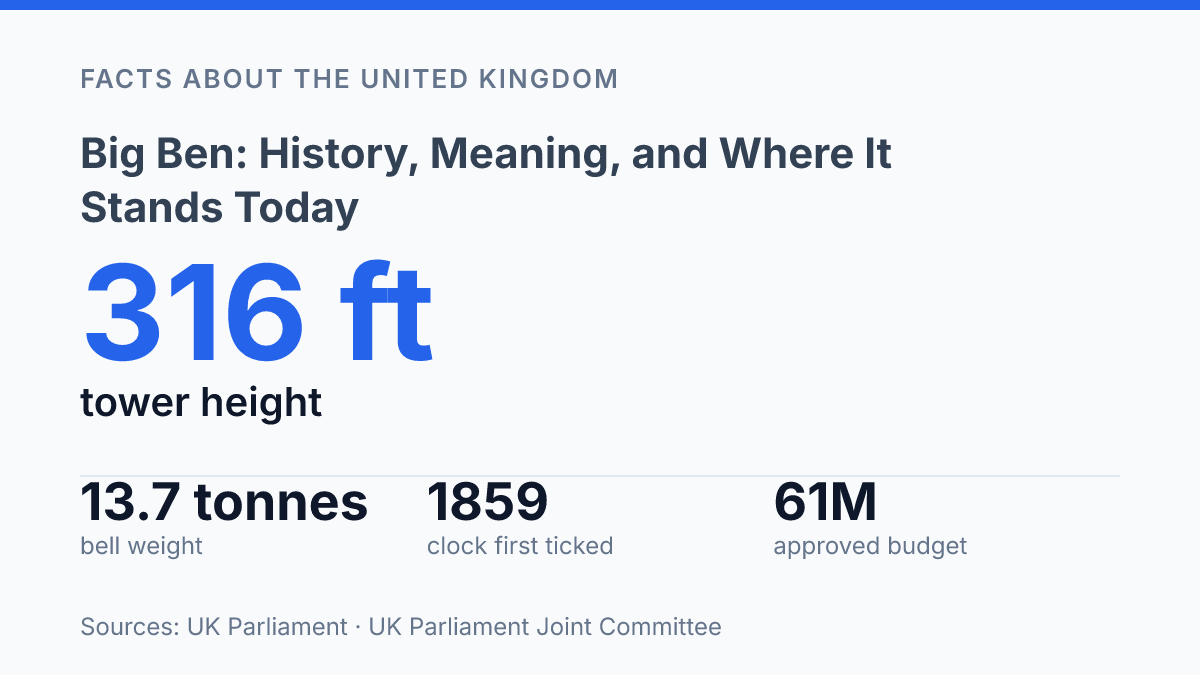
Big Ben is not the 96.3-metre tower on the Westminster skyline but the 13.7-tonne Great Bell inside it, struck by a 200 kg hammer. That distinction is more than a naming correction; it explains why one of Britain’s most familiar landmarks is also a precise Victorian machine, a post-fire reconstruction project, and a symbol whose public meaning has shifted over time. The Elizabeth Tower rose from the rebuilding of the Palace of Westminster after the 1834 fire, with its foundation stone laid in 1843 and the Great Clock first ticking on 31 May 1859.
Its scale is equally concrete: 850 cubic metres of stone, 2,600 cubic metres of brick, four seven-metre clock dials, and maintenance methods that still include pennies placed on the pendulum. The landmark’s history is therefore not only architectural, but mechanical, political, and public.
What Big Ben Actually Refers To
The name Big Ben technically belongs to a 13.7-tonne bell, not to the clock faces or the tower that most visitors picture first. As UK Parliament records, the nickname refers to the Great Bell of the Great Clock of Westminster; it weighs 13.7 tonnes, is 2.2 metres high, measures 2.7 metres in diameter, and is struck by a 200 kg hammer.
How the Clock Tower Was Built
The tower’s medieval-looking stonework began as a Victorian rebuilding project, not as a surviving medieval structure. Construction of the clock tower started on September 28, 1843, within the wider reconstruction of the parliamentary buildings after the destructive fire of 1834. That context explains the tower’s historical appearance: its Gothic Revival style was a deliberate 19th-century design choice, shaped by ideas about national tradition, public authority, and architectural continuity.
The design is associated with Augustus Pugin and Charles Barry, whose work combined an imposing parliamentary plan with highly detailed Gothic ornament. Barry was responsible for the broader architectural scheme, while Pugin’s influence is strongly visible in the vertical emphasis, tracery, pinnacles, and decorative detail that give the tower its distinctive profile. The result was not a medieval replica, but a Victorian interpretation of medieval architecture adapted to a major civic building.
At 96 m high, the tower was built on a scale that made it a dominant feature of the Westminster skyline. UK Parliament gives the more precise height as 96.3 metres, or 316 feet, which helps explain why the structure reads as both a clock tower and a public monument. Its height also gave the clock faces long-distance visibility, making the building’s practical timekeeping role inseparable from its symbolic presence.
The structure’s scale is also evident in its materials. According to UK Parliament, the tower contains about 850 cubic metres of stone and 2,600 cubic metres of brick, including Anston stone, Clipsham stone, and Caen limestone. These materials allowed the tower to combine mass, durability, and surface detail, supporting both the engineering demands of a tall masonry structure and the ornamental expectations of Gothic Revival design.
Key Facts About the Westminster Tower
The landmark’s formal address is not a separate monument site but the parliamentary estate itself: London SW1A 0AA, United Kingdom. It forms part of the Palace of Westminster, which places the tower within the working complex of the UK Parliament rather than in a standalone civic setting. That context helps explain why official information about the structure is tied to parliamentary sources and estate management, even though public attention usually focuses on the clock and bell.
Reference details list the tower as having 11 floors, a useful corrective to descriptions that reduce it to a clock face and sound. The floor count points to a substantial vertical structure with internal levels for access, maintenance, and the machinery associated with the clock. Its public image may be dominated by the exterior, but its basic plan is that of a functioning tower embedded in a larger institutional building.
The tower opened on May 31, 1859, the date commonly used to mark its entry into public life. That opening date gives the landmark a clear chronological anchor, but its later fame cannot be explained by age alone. Its standing grew from the way the tower came to represent national timekeeping and parliamentary continuity, making the date a starting point rather than the full reason for its recognition.
Why the Landmark Remains So Recognisable
A clock tower becomes a constitutional symbol less through height than through adjacency: this one is read against the debating chambers, rituals, and public authority of Parliament. Standing at the north end of the Palace of Westminster in central London, the tower is not an isolated monument but part of the built setting of national government. That location shapes its meaning because its silhouette is repeatedly seen beside the institution most closely associated with UK law-making and political accountability.
Public recognition is reinforced by the tower’s visibility in civic and media contexts. According to UK Parliament, the Great Clock has four dials, each 7 metres across, with faces made from 324 pieces of pot opal glass and lit from within.
Those design features make the clock legible as an image as well as a working instrument, especially in views across Westminster and along the Thames. In practice, the landmark’s recognisability comes from a combination of architecture, repetition, and setting rather than from a single feature.
Modern polling gives a measured indication of how widely the landmark is known within the United Kingdom. YouGov’s 2026 public ratings page recorded 100% fame among UK respondents, alongside 69% popularity, 4% dislike, and 27% neutral opinion. The fame figure should not be treated as proof of universal global recognition, but it does show how completely the image has entered domestic public consciousness.
Its symbolism is strongest when the clock tower is understood as both emblem and mechanism. It can stand for Parliament, London, and national identity in photographs, broadcasts, and public references, yet its ordinary purpose remains that of a clock tower housing a bell. That dual role helps explain why the landmark has remained recognisable: it is visually fixed beside political power while still performing a practical public function.
Why the upkeep now matters as much as the image
The clearest measure of the landmark’s future may be the cost and care required to keep an old public machine working in plain sight. The 2017 to 2022 conservation project reached £88 million after hidden asbestos and Second World War bomb damage were found, showing that preservation is rarely a simple act of repair.
Public recognition remains unusually strong, with YouGov recording 100% fame for Big Ben among UK respondents in 2026, but fame does not reduce the practical burden of stewardship. The tower’s next century will depend less on its silhouette than on the less visible work behind it: inspection, funding, conservation judgement, and the continued accuracy of a clock that still has to earn its authority every minute.
Frequently Asked Questions
Q: What does Big Ben actually refer to?
A: Big Ben is the nickname for the Great Bell inside the Great Clock of Westminster. In common use, the name is also applied to the clock tower at the north end of the Palace of Westminster in London. The distinction matters because the tower and the bell are not the same object.
Q: Where is Big Ben located in London?
A: Big Ben stands at the Palace of Westminster in London, England, with the address listed as London SW1A 0AA, United Kingdom. It is part of the parliamentary estate and sits at the north end of the complex. The tower is one of the most recognizable landmarks in central London.
Q: How tall is the Big Ben clock tower?
A: The tower rises to 96 m, making it a prominent feature of the Westminster skyline. Its height, combined with its Gothic Revival design, gives it a strong visual presence beside the Palace of Westminster. The scale also reflects the monumentality typical of 19th-century public architecture.
Q: When was Big Ben built and opened?
A: Construction began on September 28, 1843, and the tower was opened on May 31, 1859. The project was designed by Augustus Pugin and Charles Barry, with the tower completed in the Gothic Revival style. These dates place it firmly in the mid-Victorian period.
Q: Can visitors go inside Big Ben?
A: Access to the tower is limited and usually arranged through official parliamentary channels rather than as a casual public visit. The main public-facing interest is often the exterior, the clock face, and the wider Palace of Westminster setting. Enquiries are typically handled via the Palace of Westminster contact number, +44 20 7219 4272.