
Liverpool went from a fishing village in the 1690s to about 80,000 people by 1800. The Mersey explains the jump. The river made money move.
It also moved people, some by choice and others through a trade the city can’t soften. By the 1740s, its port had become Britain’s chief transatlantic slave-trade port. That fact changes the way the waterfront should be seen.
The Three Graces are beautiful. They are not harmless decoration. They are stone proof of ambition, shipping power, insurance, migration, and loss.
Then comes the other shock: the same city that sent 9 million emigrants across oceans now pulls music fans to Mathew Street and ferry passengers onto the river. In my honest opinion, the city makes most sense when you treat the waterfront as the main text, not the backdrop.
This guide follows that line: river, skyline, Beatles mythology. The water you can still ride today.
Why the Mersey shaped the city
Where the River Mersey meets the Irish Sea, the city got a working front door to the Atlantic rather than a decorative waterfront. That meeting point gave ships a route west and a sheltered base to load, repair, and return.
Geography did the first piece of work. Commerce did the rest.
According to Liverpool John Moores University / Europe Insight, the settlement grew from little more than a fishing village in the 1690s to around 80,000 people by 1800, and by the 1740s its port had become the UK’s, and probably Europe’s, principal transatlantic slave-trade port. That speed of growth was not normal urban drift. It was port power.
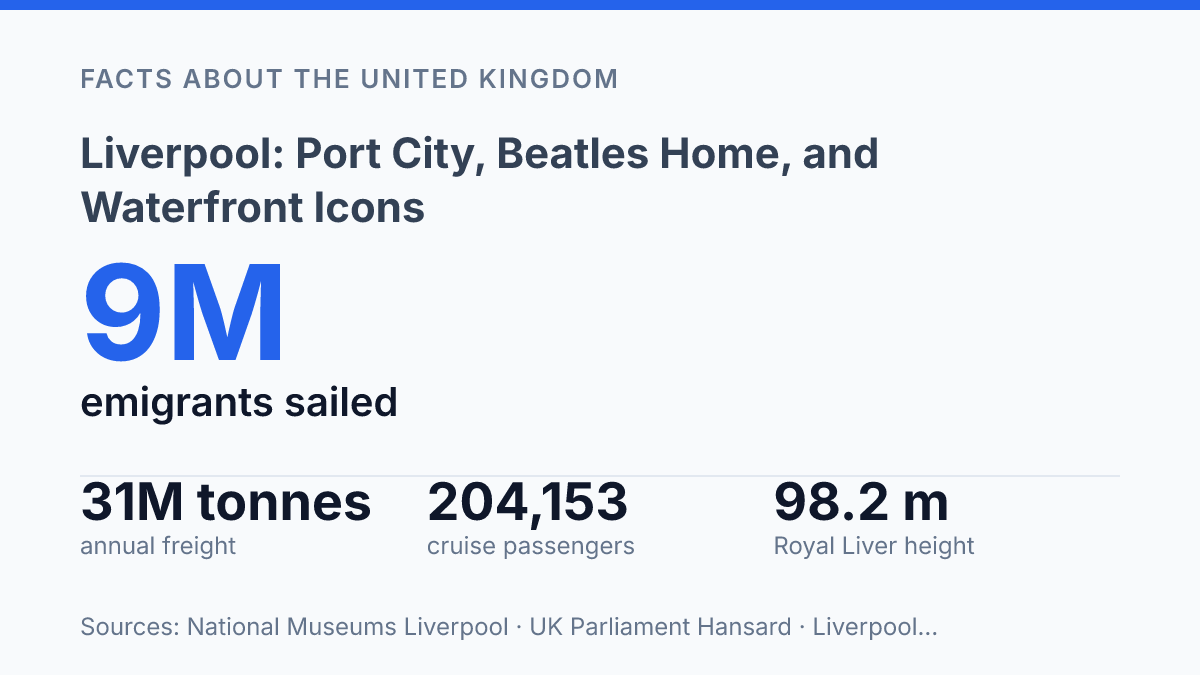
From the 18th century into the early 20th, the river helped turn the city into one of the great gateways of the Atlantic world. Ships moved cotton, sugar, manufactured goods, and people across ocean routes. National Museums Liverpool records about 9 million emigrants sailing from the city to North America, Australia, and New Zealand, which made it the largest emigration port in the world at the time.
The same network that filled warehouses and funded civic ambition also tied the city to harder histories of empire, slavery, displacement, and departure. Wealth came in on the tide, but so did grief. In my view, that contradiction matters more than any romantic image of sail masts and dock lights.
The river still gives the city its posture. Streets, docks, and public memory all lean toward the water, as if the Mersey remains the main entrance.
You don’t understand the place by treating the waterfront as an edge. It is the line that made the city face outward.
The waterfront buildings that define the skyline
The Liver Birds sit above the river like civic punctuation marks. The buildings beneath them do the real talking.
On the Pier Head along Liverpool’s waterfront, the Three Graces turn commercial administration into theatre: the Royal Liver Building, the Cunard Building. The Port of Liverpool Building stand shoulder to shoulder like a boardroom made of stone.
Each one has a different accent. The Port of Liverpool Building, completed in 1907, carries the domes and ceremony of imperial bureaucracy, fitting for the former Mersey Docks and Harbour Board offices, according to Historic England.
The Royal Liver Building is sharper and more vertical. CTBUH records it at 98.2 metres, a height that still gives the skyline its most familiar outline.
The Cunard Building brings a heavier, transatlantic confidence. Built between 1914 and 1917, it housed a company whose name belonged to ocean liners and global routes. That matters.
These weren’t decorative riverfront trophies. They were working headquarters for firms and institutions that turned maritime trade into civic power.
Yet their confidence has a ghost in it. The buildings still project command, wealth, and order.
They belong to a shipping era that no longer exists in the same form. You can admire the grandeur and still feel the distance between those carved façades and the containerized, security-controlled port economy of today.
That tension is what makes the Pier Head more than a postcard view. In my honest opinion, the skyline works because it doesn’t hide the city’s old ambition behind soft nostalgia. It puts the evidence in plain sight: commerce wanted to look permanent, and for once, architecture made that claim stick.
How the city became a Beatles destination
A cellar club on Mathew Street now anchors a global pilgrimage, yet its power comes from being ordinary: low ceiling, brick walls. A stage you can almost miss. The Beatles were formed in Liverpool in 1960. The story visitors come to trace is less about celebrity than geography.
The band’s early world was compact. Clubs, cinemas, suburban roads, bus routes, and school friendships all sat close enough to connect by foot or short ride.
That matters because the city sells place, not just nostalgia. The Cavern Club remains the sharpest example. It isn’t a preserved time capsule.
That can disappoint purists. Still, the address carries weight. According to the city’s official tourism agency, the band performed there 292 times, a number that turns a tourist stop into a working piece of music history.
Penny Lane does something different. It proves how a normal street can become shorthand for a whole city. Visitors photograph the sign.
The stronger detail is how little the setting tries to perform. Shops, traffic, and nearby homes keep the song grounded. In my humble opinion, that everyday texture is what makes the site more powerful than a polished monument.
Tourism has built a large structure around those local anchors. The Beatles Story drew 240,750 visitors in 2024, according to the 2025 regional tourism dashboard. Walking tours, taxi routes, museum displays, and music heritage stops now link places such as the Cavern Quarter, Penny Lane, Strawberry Field, and childhood-home locations into a clear visitor trail.
There is a tradeoff, though. The city is proud of its most famous sons, but Beatle fame can flatten the place into a postcard and push its older working-port identity into the background. The best tours resist that.
They keep the music tied to streets, accents, class, and local movement. If you follow the trail closely, you don’t just see where songs came from. You see how a port city turned local experience into exportable culture.
What to see on the water today
A ferry ticket gives you the waterfront’s best angle: the skyline lines up, the river opens out. The buildings stop feeling like postcard props. Mersey Ferries still matter for movement, but their real public value is visual.
They turn the river into a viewing platform. According to the City Region Destination Partnership’s 2025 dashboard, the ferries drew 364,075 visitors in 2024, which shows how strongly the river still pulls people onto the water.
Pier Head works in a different way. You don’t need to board anything to understand the place. Stand there and you get the Three Graces in one direction and the Mersey in the other.
That simple back-and-forth is the point. The waterfront asks you to look at architecture, then look past it.
The area can feel timeless. That impression is a trick. This is still a working edge of the city, not an outdoor museum. Freight, ferries, cruise calls, commuter movement, public walks, and sightseeing all compete for space along the same strip of water.
The port still handles 31 million tonnes of annual freight, according to UK Parliament Hansard. The river is not just scenery. It carries money, logistics, and pressure.
That contrast gives the waterfront its bite. Heritage sites invite slow looking. Modern use demands constant adjustment.
Cruise passengers arrive close to civic landmarks. Ferries share the estuary with commercial traffic. Public promenades sit beside infrastructure that has to function, not merely look good.
In my view, the best way to read the waterfront is from both sides: first from Pier Head, where the skyline feels composed and ceremonial, then from the river, where it looks exposed, practical, and alive. One view flatters the city. The other tells the truth.
Why the view from the water changes the trip
Choose the river first if you want the city to click. The Mersey is not a scenic edge. It is the operating system.
That matters more now, not less. In 2025, cruise traffic reached 204,153 passengers, while freight, ferries, and dock traffic still shared the same working water. The postcard view has to coexist with cranes and schedules.
In my humble opinion, that’s what makes the place sharper than a standard music pilgrimage. Go for the Beatles, but don’t stop at the club door. Stand by the Pier Head and watch what moves.
The city reveals itself in motion… not in a single landmark, but in the traffic between memory and departure.
Frequently Asked Questions
Q: Why is Liverpool so famous?
A: Liverpool became a major maritime city because of its port history on the River Mersey. It also has global pop-culture pull as the hometown of The Beatles. In my view, that mix of shipping heritage and music history is what makes the city feel bigger than its size.
Q: What are the Three Graces in Liverpool?
A: The Three Graces are the Royal Liver Building, Cunard Building, and Port of Liverpool Building on the Pier Head. They’re the waterfront’s best-known landmarks. They give the city its dramatic first impression. The trio matters because they show how much money and ambition once moved through the port.
Q: Can you take a ferry in Liverpool?
A: Yes, ferries still run across the waterfront and give you a clear view of the city from the water. That’s the best way to feel the Mersey connection without standing in the middle of the crowds. It’s practical, but it’s also the scenic option.
Q: Why was Liverpool such an important port?
A: Liverpool grew into a key trade and migration port from the 18th to the early 20th centuries. Ships carried goods, people, and ideas through the city at a scale that shaped its economy and identity. The port made Liverpool matter far beyond northwest England.
Q: What should I see first in Liverpool?
A: Start at the Pier Head if you want the quickest read on the city. You get the waterfront, the Three Graces. The Mersey all in one place. In my honest opinion, that single stretch tells the story better than rushing from one landmark to the next.