
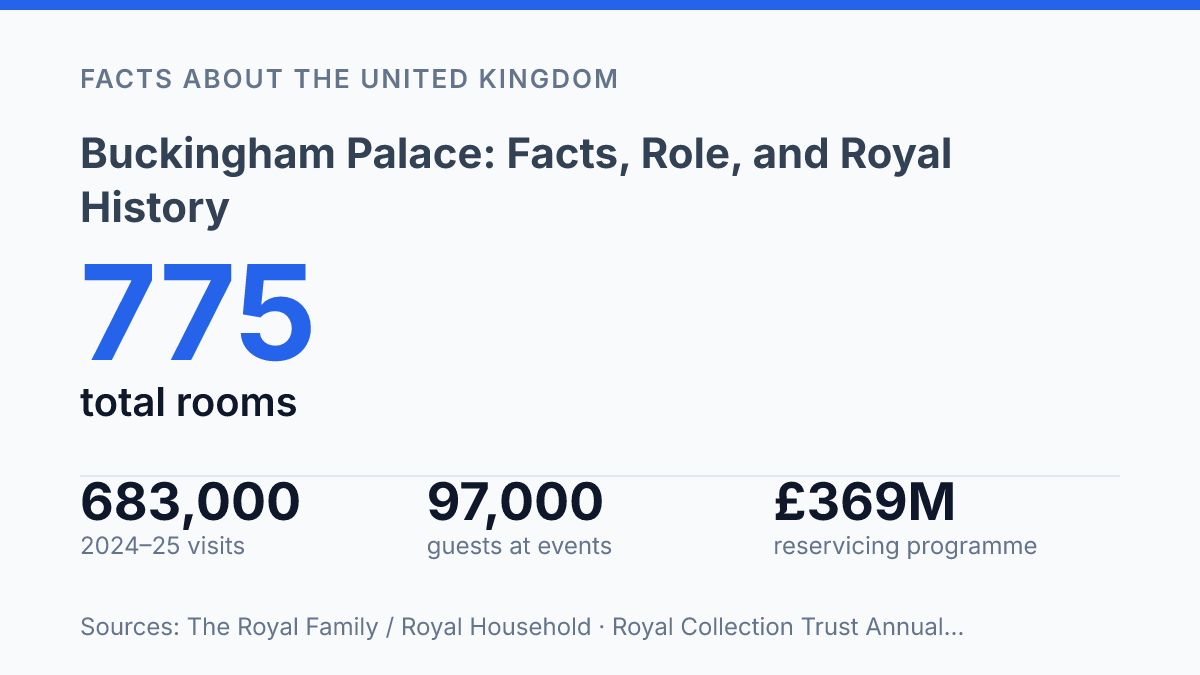
Buckingham Palace drew 683,000 visits in 2024–25, its highest paid-entry figure since 1993, but its royal role is newer than many London train stations.
Only in 1837 did Queen Victoria make it the official seat of the court. Before that, it was Buckingham House, bought by George III in 1762 for Queen Charlotte and their children.
That shift matters. In my honest opinion, the palace is not just a symbol of monarchy. It’s a machine built for power, ceremony, staff work, tourism, and repair.
Behind the balcony sits a 775-room operation with offices, bedrooms, bathrooms, State Rooms. A garden the size of about 22 football pitches.
This guide looks past the postcard view. You’ll see how the residence became a royal headquarters. You’ll also see what happens inside, why the public keeps coming, and how much work it takes to keep the gates open.
How Buckingham Palace became the monarch’s base
The strangest thing about Britain’s best-known royal address is that it began as one aristocrat’s townhouse, not a palace built for a crown. Built in 1703 for John Sheffield, Duke of Buckingham and Normanby, Buckingham House sat in London as a private property with a grand name and a limited public role.
That origin matters. The building started with ownership, not monarchy.
George III changed its direction without making it the full seat of royal power. He acquired the house in 1762 for Queen Charlotte and their children, then reshaped it into a royal family residence.
Sir William Chambers’ remodelling cost £73,000, a huge sum that shows how quickly a private house could become a dynastic asset. But it still wasn’t the main base of the court.
The decisive break came in 1837, when Queen Victoria became the first sovereign to rule from there. The Royal Collection Trust records that she and Prince Albert then spent more than 20 years turning it into a centre for official business and entertainment. That shift is the whole story: Buckingham Palace moved from private townhouse to the most visible state residence in the country. In my view, that private-to-public conversion is what gives the building its real force.
Its location in the City of Westminster, London, sharpened that role. The monarch needed more than a residence. The Crown needed a place where administration, ceremony, audiences, and government-facing duties could meet.
The palace became that working centre. It still carries the tension of its origins: a domestic house enlarged into a national symbol, with private rooms behind a public front.
What happens inside the palace today
In 2025–26, almost 97,000 guests attended 827 Palace events, according to the Royal Household. That is not footfall. It is workload.
State occasions give the building its public rhythm. Investitures turn national honours into face-to-face moments, with recipients receiving insignia from the sovereign or another member of the Royal Family. Receptions do a different job: they gather people from public service, charity, diplomacy, culture, science, the armed forces and business under royal patronage.
The less visible work matters just as much. The monarch holds formal audiences there, including meetings with the Prime Minister and diplomatic representatives presenting credentials. Behind those set-piece encounters sits a steady administrative machine: Private Secretaries prepare papers, manage correspondence, shape diaries and support decisions that carry constitutional weight.
It looks like a symbol first. It still runs as an office… and that mix of ceremony and routine is what most people miss. In my honest opinion, the balcony gets the photographs. The desks explain why the place still matters.
A royal residence without daily administration would be theatre. This one is not.
Foreign visits show the same double function. Heads of state and senior dignitaries may be welcomed through formal ceremonies, private meetings, receptions and banquets. The hospitality is polished.
It is never just decorative. It signals diplomatic respect in a language that governments understand.
There is a tradeoff here. The palace must project continuity. It has to handle schedules, security, protocol, staffing and official records with the discipline of a major institution.
Ceremony can look slow from outside the gates. Inside, it depends on timing, paperwork and people who cannot afford to miss the details.
Why the palace matters to the public
One balcony can do what a televised address rarely can: make the monarchy look close enough to cheer back. During coronations, jubilees, royal weddings and birthday parades, the appearance above the gates turns a private residence into a shared national image.
The crowd sees a family. It also sees continuity staged in plain sight.
That public joy has a grammar of its own. People gather outside, look toward the façade, and wait for a wave that lasts seconds. In my humble opinion, that brevity is part of the power. The palace gives the public just enough access to feel included, then closes the distance again.
Grief works differently. It pulls people to the same railings.
After Queen Elizabeth II died in 2022, crowds came to leave flowers, stand in silence, and mark the end of a reign together. The building became less a backdrop than a place where private loss and public history could meet.
The same pattern appeared after the death of Diana, Princess of Wales in 1997, when flowers, notes and tributes gathered outside the gates. That moment exposed the tension at the heart of the palace. It belongs to the Crown, but people still treat its edge as a civic space when ordinary words aren’t enough.
The Changing of the Guard adds a different kind of public meaning. Its value isn’t only spectacle, though the uniforms and music make it easy to watch. The ceremony lasts about 45 minutes, but its real message is older and sharper: the state is still being guarded, in public, by ritual.
That contradiction gives the palace its cultural weight. You can stand with thousands outside it, cheer from the Mall, mourn at the gates, and watch ceremony unfold nearby. But you can’t fully enter the world it represents.
The distance frustrates people at times. It also keeps the building charged with symbolism.
Rooms, grounds, and the working scale behind the gate
The most revealing number isn’t the count of grand rooms. It’s the 188 staff bedrooms tucked inside a palace most people picture only from the front gates.
The headline figure is 775 rooms. The breakdown tells the better story: 19 state rooms carry ceremony, 52 royal and guest bedrooms handle residence and hospitality, 188 staff bedrooms support the people who keep the place running, 92 offices process the work, and 78 bathrooms remind you that scale creates ordinary problems too.
The numbers sound grand. The surprise is practical.
That practical side shows up in the fabric of the building itself. A 10-year reservicing programme began in 2017, backed by £369 million in public funding, according to GOV.UK. Pipes, wiring, heating, lifts, and safety systems matter here as much as gilded ceilings.
Maybe more. In my view, that’s the least glamorous detail. It explains the building better than any ceremonial photograph.
Behind the palace sits the largest private garden in London, a working outdoor space rather than a decorative afterthought. The Royal Collection Trust puts it at 16 hectares, or 39 acres, which is about 22 football pitches. It holds more than 1,000 trees, hundreds of wild-plant species, and breeding birdlife.
It also has to serve formal hospitality and managed public access. Nature and protocol share the same lawn.
The front balcony works in the opposite direction. It compresses the whole complex into one public image. A few people step out, cameras lock on.
The building becomes a national stage. That view is powerful. It hides the machinery behind it: staff corridors, offices, service routes, security planning, maintenance schedules, and constant movement out of sight.
According to the Royal Household, the palace’s room count reflects both ceremony and day-to-day operation. That balance is the point.
The building isn’t just large because monarchy likes scale. It’s large because it has to absorb residence, workplace, event venue, archive, security zone, garden estate, and public symbol all at once.
What the palace asks of you now
The next phase is less romantic: a £369 million reservicing programme must keep a palace open, safe, and useful without draining the spell from it. That work began in 2017. It says more about the building than another balcony photo ever could.
When George III bought Buckingham House for his family, he wasn’t buying a museum. The same is true now. Buckingham Palace has to host presidents, process staff rotas, protect art, welcome tourists, and still feel like a national stage.
That’s a hard balance, not a fairy tale. In my humble opinion, Treat your next look at the gates as a question: how much public value should a working monarchy be expected to show from behind them?
Frequently Asked Questions
Q: What is Buckingham Palace used for today?
A: It serves as the monarch’s London residence and the working base for royal business. State occasions and official hospitality happen there all the time, but it’s not just a ceremonial backdrop. That mix of home and headquarters is what makes it matter.
Q: Where is Buckingham Palace located?
A: It stands in the City of Westminster in London, England. That location puts it right at the center of national life, which is part of why it draws so much attention. In my view, the setting matters almost as much as the building itself.
Q: Why is Buckingham Palace so important to the UK?
A: It’s the official base of the monarch. It carries real constitutional and public weight. People also connect it with major moments of celebration and grief, which gives it a role that goes beyond architecture. That emotional pull is a big part of its power.
Q: Is Buckingham Palace the private home of the monarch?
A: It’s a royal residence, but it’s also an administrative headquarters. That means it functions as both a home and a workplace, which is not how most people picture a palace. The public role comes first… and that’s what makes it unusual.
Q: Why do people gather outside Buckingham Palace?
A: People go there for royal events, public ceremonies, and moments that feel nationally significant. The palace has become a focal point for the British people during both rejoicing and mourning. That contrast is the point. It reflects the way the monarchy still sits at the center of public ritual.