
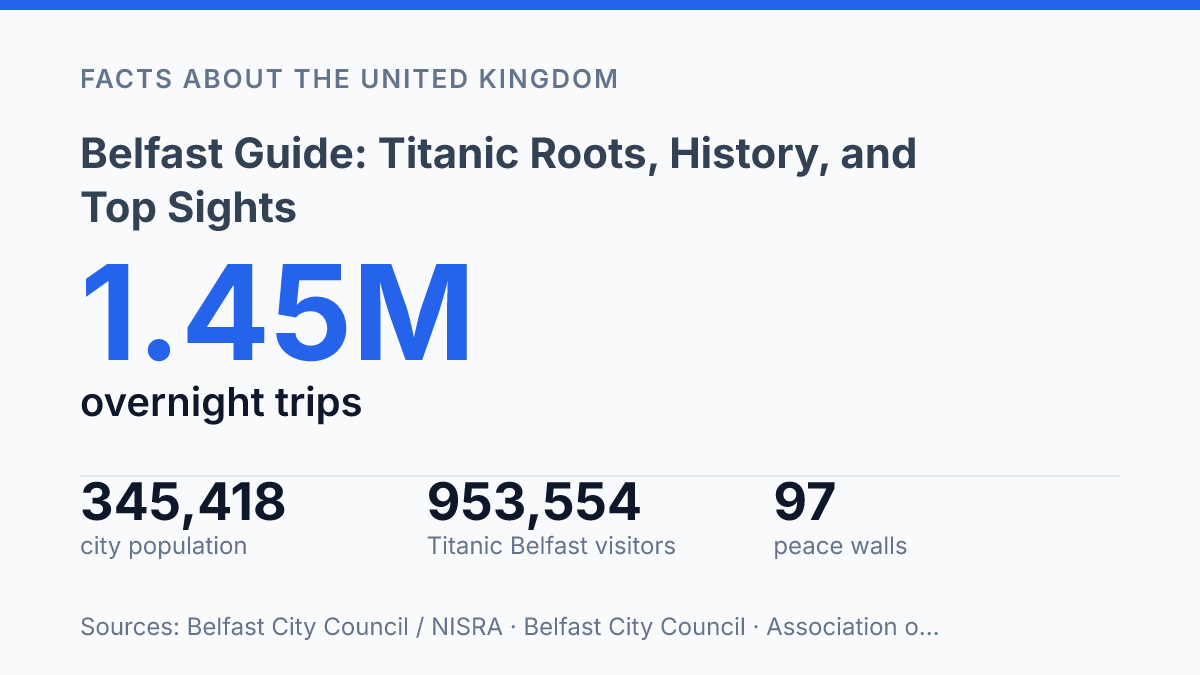
Belfast drew 1,452,849 overnight trips in 2024, yet its core population is only 345,418. That mismatch tells you almost everything. This isn’t a small capital with one famous ship story attached.
It’s a regional engine of more than 1.12 million people, a working port. A city still negotiating what visitors think they came to see.
The Titanic connection gives the trip its headline. Harland & Wolff gives it steel, scale, and two cranes you can spot before you understand why they matter.
But the sharper story sits in the gaps: a 185-acre waterfront remade for tourists and firms, peace walls that still divide streets. A cultural future being planned in bricks, museums, and money. In my honest opinion, the best way to read this city is to treat Titanic as the doorway, not the destination.
Belfast as Northern Ireland’s capital
A city of 345,418 residents can still carry the weight of a national capital, with more than 1.12 million people in its wider region, according to Belfast City Council. That resident figure comes from the 2021 Census.
It matters. It shows a compact core with a much bigger pull than its municipal boundary suggests.
It is the capital and largest city of Northern Ireland. The city carries the region’s main civic functions.
Government, courts, higher education, media, and major cultural institutions all cluster here. That gives the place a formal authority you feel quickly, even on a short visit.
The geography is just as important. The city sits on Belfast Lough in County Antrim, with its centre set close to the water and backed by hills.
That setting shaped its trade, its streets, and its sense of outward connection. You don’t need to know every district to understand the basics: this is a port capital, not an inland administrative town.
In my view, the city’s political status matters, but its identity is bigger than government offices. It feels defined as much by industry and memory as by administration. That contrast is the key.
The official capital has a practical, civic face. The emotional city is harder-edged and more layered.
For visitors, that means the capital label should be treated as a starting point, not the whole story. The city is small enough to read on foot in places, yet large enough to anchor daily life for a much wider region. That scale explains why it can feel both local and metropolitan at the same time.
The shipyard story that still shapes the city
RMS Titanic entered the water before she entered legend: built by Harland & Wolff in Belfast, she was launched on 31 May 1911, nearly a year before the name became shorthand for catastrophe.
That timing matters. The ship was not born as a tragedy here. She was a product of skill, scale, and industrial confidence.
Harland & Wolff gave the city wages, apprenticeships, engineering status. A working waterfront that shaped family life for generations.
The famous yellow cranes make that history impossible to miss. Samson and Goliath came later, completed in 1974 and 1969. They still act like civic punctuation marks.
They tell you this wasn’t a decorative maritime past. It was heavy industry, steel, noise, risk, and pride.
Then came 15 April 1912. The liner sank after striking an iceberg. The world attached the city’s craftsmanship to one of the most famous disasters in modern history.
That link still pulls visitors across oceans. It also narrows the story. In my honest opinion, and that’s a problem for a city with much more to sell.
The money is real. Titanic Belfast reached its 10 millionth visitor on 5 May 2026, according to Titanic Belfast, with guests from 145 countries and more than £70 million a year in extra spend generated for Northern Ireland. Tourism built on the shipyard story now supports jobs, hotels, restaurants, taxis, and guided tours.
Yet civic pride here works best when it refuses to be sentimental. The Titanic connection brings crowds. The deeper achievement is the workforce that made such a vessel possible.
Remembering only the sinking flattens the city. Remembering the shipyard restores its scale.
What to see in the Titanic Quarter
The most revealing thing in the Titanic Quarter is not the museum’s shine. The way the old slipways still get used after dark. This is heritage with a calendar attached: tours by day, open-air concerts and large public events when the space shifts gear.
Start with Titanic Belfast, the aluminium-clad museum opened in 2012 and shaped to suggest a ship’s hull. The building works best when you treat it as a marker, not just an attraction.
It gives the quarter a visual anchor. You can understand where the story sits on the waterfront before you walk the ground itself.
The Titanic Slipways carry more weight than any polished display case. They are broad, exposed, and practical, which is exactly why they still work as event space. That modern use makes the area feel alive, but there’s a tradeoff: stages, lighting rigs, and crowds can soften the harder industrial history under your feet.
A short walk away, Harland & Wolff’s Drawing Offices add a different kind of drama. These were thinking rooms, not showpieces. Their value for visitors is simple: they connect the dockside scale outside with the precision that happened indoors, where huge ideas became measured plans.
The quarter now covers 185 acres of waterfront land, according to Titanic Quarter’s 2026 figures, so don’t treat it as a single-stop museum visit. Give yourself time to move between the museum, the slipways, the Drawing Offices. The surrounding dock edges. In my humble opinion, the best visit happens when you let the polished regeneration and the rougher working past sit uncomfortably beside each other.
How to read the city beyond Titanic
The Cathedral Quarter gives the sharpest correction to the waterfront: tighter streets, louder walls, and culture that doesn’t ask to be solemn. Its pubs, street art, small galleries, and performance spaces make the city feel lived-in rather than curated. The MAC and the Black Box matter here not as boxes to tick, but as proof that local culture still happens at street level.
City Hall pulls the story in another direction. Completed in 1906, it turns civic pride into stone, dome, and ceremony. Set around Donegall Square, it shows the confidence of a city that wanted to be seen as powerful, orderly, and imperial.
But that grandeur lands differently now. You read it alongside murals, memorials. The quieter evidence of division.
The harder layer is political memory. The council says 97 physical barriers, commonly called peace walls, still remain across the city. That number matters because it stops the place from becoming a polished visitor product.
Industrial heritage, political history, and modern cultural life don’t sit in separate chapters here. They overlap every few blocks.
In my view, Belfast works best when you stop treating it as a museum piece. The real appeal is how easily a grand civic building, a pub street. A shipyard all sit in the same conversation.
That mix can be uncomfortable, but it’s also what gives the city its force. If you only chase the famous story, you miss the argument happening around it: a place shaped by work, conflict, reinvention, and ordinary nights out.
What the famous ship can’t explain
Plan the trip as if the famous ship is only your first appointment. The city makes more sense when you leave space between timed tickets. Walk the river, then cross into streets where memory hasn’t been polished for visitors.
The next chapter won’t erase that tension. Belfast Stories is planned for 2028, and 97 physical barriers still stand across the city. That contrast matters. A new cultural venue can pull people in.
It can’t replace the slow work of looking closely. In my humble opinion, the visitors who get the most from this place are the ones who resist the easy version. Come for the ship. Stay alert for the city it left behind.
Frequently Asked Questions
Q: Why is Belfast linked to the Titanic?
A: The city built the RMS Titanic. That history still shapes how people visit it today. The ship was launched from Belfast in 1912, then struck an iceberg and sank the same year. In my view, that link matters because it gives the city a story with real weight, not just a museum label.
Q: What is Titanic Belfast, and is it worth visiting?
A: Titanic Belfast is the main museum in the old dockyards. It opened in the renovated Titanic Quarter and sits in an aluminium-clad building that echoes a ship’s hull. If you want the shortest path to the city’s shipbuilding story, this is the stop to make.
Q: What can you see in the Titanic Quarter?
A: You can see Titanic Belfast, Harland & Wolff’s Drawing Offices. The Titanic Slipways. The area turns industrial history into something you can actually walk through… and that contrast is the point. It feels lived-in, not polished to death.
Q: Are the Titanic Slipways used for anything today?
A: Yes. The Titanic Slipways now host open-air concerts. The old launch site has a second life. That mix of memory and live events works better than a frozen monument ever would.
Q: What are the top sights to see in Belfast for first-time visitors?
A: Start with the Titanic Quarter, then branch out to the places that explain the city’s past and present. Belfast is Northern Ireland’s capital, so you’ll find history, civic life, and waterfront sights in one trip. If you only have a short stay, this is where the city makes the strongest first impression.