
London is a city where the pavement can sit 6 metres above the Roman streets that started it all. Londinium began around AD 50. The capital still behaves less like a museum than a machine under constant repair.
That contrast is the point. In my honest opinion, the best facts about this place aren’t trivia. They’re proof that old power and new pressure keep sharing the same streets.
Westminster still stages monarchy on a scale that feels almost improbable: a coronation in 2023, the 39th at the Abbey since 1066, with 2,300 people inside. Across the river, the South Bank pulls culture, tourism, and planning into one frame.
The Eye got permanent permission in 2024, but even icons have to justify their place here. This guide follows the city’s deeper layers, public symbols, riverfront changes, and stubborn habit of remaking itself without becoming somewhere else.
From Roman settlement to capital city
The City of London records Londinium as founded around AD 50, with 20,000–30,000 people by the mid-2nd century and modern street level about 6 metres above the Roman remains.
That dating sits just after Rome’s invasion of Britain in AD 43 under Emperor Claudius. The town grew where roads, river traffic, taxation, and military control met. Rome supplied the grid.
The river supplied the trade. That pairing made the settlement useful before it became symbolic.
The strange part is how little of that Roman city sits in plain sight. The oldest foundations now lie below glass offices, rail lines, courts, banks, and streets built for a capital with global reach. In my view, the clash is the point: this city doesn’t preserve history by freezing it. It buries, rebuilds, and keeps moving.
Power gathered here over centuries because administration needed a fixed centre. The city became the capital of England, and later the capital of the United Kingdom, not through one clean decision but through repeated use.
Government, law, finance, and monarchy clustered close enough to reinforce each other. That made the capital durable.
Then came the Great Fire of London in 1666. It destroyed the medieval core on a scale that forced more than repair. Streets, building rules, materials, and civic ambition all changed after the flames.
But destruction did not erase the city’s role. It sharpened it.
That is the pattern from Londinium onward. A river settlement became a seat of power, then survived the kind of disaster that could have reduced another place to memory.
The result is not a museum city. It is an old capital with its foundations still pressing upward, even when you can’t see them.
Westminster’s core landmarks
The most photographed clock in the capital is famous under the wrong name. Big Ben is the nickname of the Great Bell, not the tower. That mistake tells you how quickly a working monument becomes a public symbol.
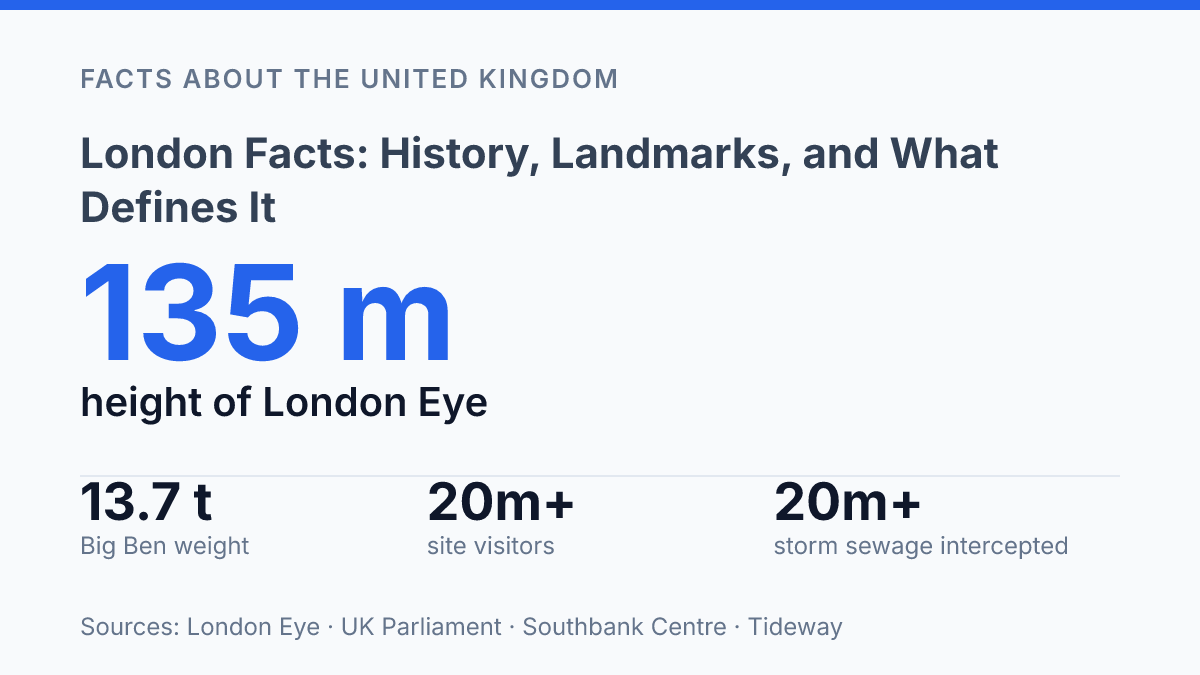
The tower is Elizabeth Tower, and UK Parliament says the bell weighs 13.7 tonnes. That is not a decorative detail. It is a physical fact behind a sound people treat almost like a national voice.
Across the road, the Houses of Parliament at Westminster carry the same double identity. Visitors see towers, stonework, river views, and ceremony. But the building is not staged scenery. It is a working seat of national debate, repair, protest, access rules, and daily business.
That tension gives the place its force. You’re not just looking at heritage. You’re standing beside machinery that still runs.
Westminster Abbey adds a different kind of authority. Its power comes from continuity, not height or spectacle.
According to Westminster Abbey, King Charles III and Queen Camilla were crowned there on 6 May 2023, continuing a coronation tradition that reaches back through nearly a thousand years of monarchy. The service drew a congregation of 2,300, which is small enough to feel human but large enough to signal the event’s state importance.
What visitors sometimes miss is that Westminster’s landmarks are not equal to ordinary attractions. In my honest opinion, their real value comes from the fact that they were never built mainly for visitors. The postcard view matters, of course. The photographs are part of the city’s global image.
But these buildings still carry law, memory, ritual, and argument. That makes Westminster heavier than it looks from the pavement.
The Thames, the South Bank, and the London Eye
The city’s best-known modern panorama was supposed to be temporary. When the London Eye opened in 2000, it marked the millennium rather than claiming a permanent place on the skyline. That makes its survival more telling: a short-term structure became one of the city’s most durable visual signatures.
The River Thames does more than separate north from south. It divides central London and links major districts at the same time, turning the river into both a boundary and a route. That tension matters, because the city’s geography makes more sense when you read it from the water rather than from a street map.
Across the river, the South Bank works as a cultural edge rather than a formal seat of power. The Southbank Centre and National Theatre give this side of the Thames a different authority: performance, public gathering, festivals, debate. According to Southbank Centre’s 2024/25 annual accounts, its site drew more than 20 million visitors, a number that shows scale without reducing the place to tourism.
The wheel sharpened that shift. Standing 135 metres tall, with 32 capsules and views reaching up to 40 km on a clear day, it gives visitors a survey of the old civic core from a modern machine, according to the attraction’s 2025 facts page.
But its effect is not just height. It changed where people look from.
That permanence was not inevitable. Lambeth Council’s 2024 decision allowed the wheel to remain beyond 2028 and tied it to support for the surrounding public realm through 1% of annual turnover. In my humble opinion, that’s exactly why it matters: the most memorable new symbol here isn’t only an attraction. A planning decision that became part of the city’s identity.
Why London keeps changing without losing its identity
More than 270 buildings of at least 20 storeys went up between 2014 and 2024, according to NLA’s 2026 tall-buildings survey. The skyline you recognise is already partly out of date. The same survey logged 46 tall-building applications and 45 approvals in its latest year.
That isn’t cosmetic change. It shows a capital still adding height, density, and commercial floor space at speed.
London sells tradition, but its daily reality is change… and that tension is exactly what keeps it legible to the world. Older districts give the city a grammar: tight streets, preserved frontages, specialist shops, clubs, markets, offices, theatres. Canary Wharf speaks in a different register, with towers, transit links, and corporate scale built for a finance-driven age.
With more than 8 million residents, the city has the weight of a country packed into one metropolitan system. That size creates pressure. Housing strains, transport demand rises, and neighbourhoods absorb waves of newcomers who bring new food, languages, businesses, and politics.
Its status as a global financial and cultural center depends on this compression. Money moves fast. Culture moves faster.
A bank, a design studio, a university lab, a theatre producer. A street market can all operate within the same working week and the same transport map.
The risk is obvious. Reinvention can flatten character when developers treat place as branding. But preservation can also become a trap when it turns a living city into a museum.
In my view, the city’s real strength is not that it avoids change. That it forces change to argue with history.
That argument is visible in its streets, its skyline, and its working habits. Identity survives here because it’s contested every day, not because it’s locked away.
What the next skyline will ask of the city
Next time you look at the skyline, treat it as a set of choices, not a postcard. The Thames Tideway Tunnel has already intercepted more than 20 million tonnes of storm sewage since 2024.
That’s not romantic history. It’s plumbing, funding, disruption, and public space rolled into one.
The same test applies to towers, transport, and tourist magnets. London keeps its identity only when change pays rent to the street around it. In my humble opinion, the city works best when grandeur is forced to serve everyday life.
So the sharper question isn’t what should be preserved. It’s what deserves to stand next to it.
Frequently Asked Questions
Q: What is London best known for?
A: London is best known for its mix of royal history and modern landmarks. The Houses of Parliament, Big Ben, and Westminster Abbey sit at the heart of that identity. In my view, that combination matters more than any single attraction, because it tells you what the city stands for.
Q: How old is London?
A: London’s history goes back to Roman times, so it’s far older than most people expect. That long run is part of why the city feels layered rather than neatly planned. You see the old and the new side by side everywhere.
Q: Why is Westminster Abbey so important?
A: Westminster Abbey is the site of British monarch coronations. That gives it a role that goes far beyond being a famous church. It’s one of the clearest links between London and British state history.
Q: Can you see a lot of London from the London Eye?
A: Yes. The London Eye gives panoramic views of the South Bank cultural complex and the wider city. It’s a great way to understand the layout. The view also shows how much London spreads out beyond its postcard sights.
Q: What defines London as a city today?
A: London is a 21st-century city shaped by deep history and constant change. That contrast is the point. You get Roman roots, royal landmarks, and modern skyline views in one place, and that’s what makes the city stand out.