
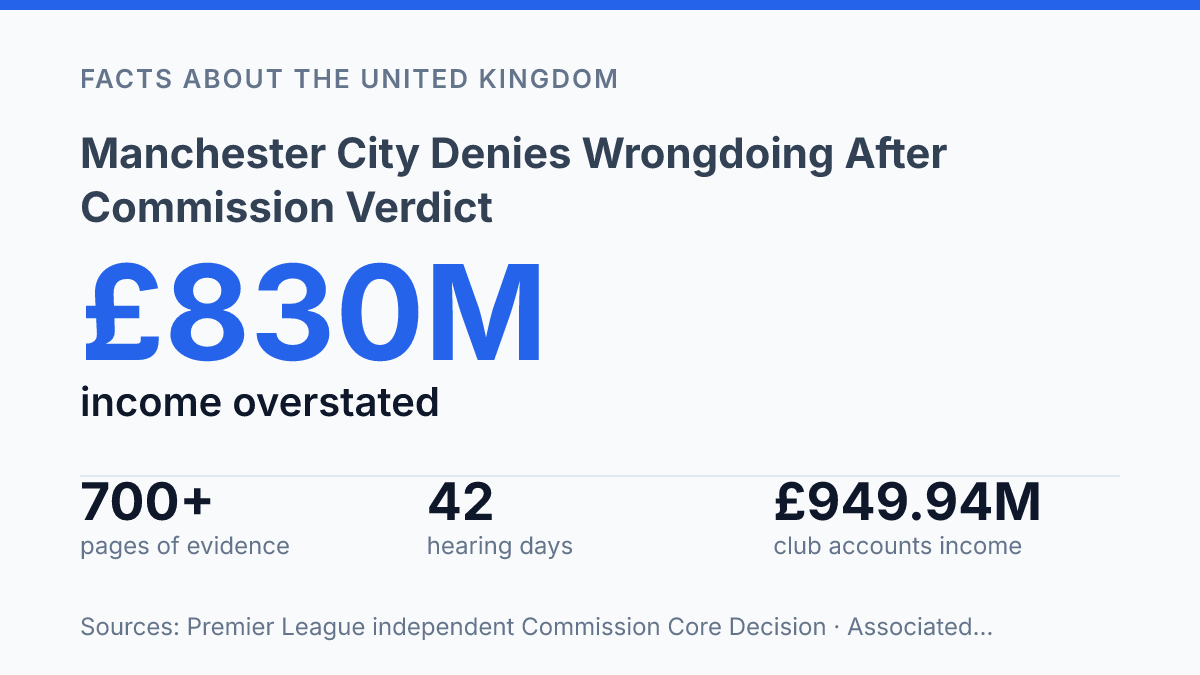
Manchester City denies wrongdoing after independent commission verdict issued on 29 September 2026, after a panel found the club guilty of serious Premier League financial-rules breaches across nine seasons from 2009/10 to 2017/18. The scale of the case was unusual even by modern football standards: the league’s charge documents and statement of facts ran to about 500 pages, the hearing lasted 42 days, and transcripts reached roughly 7,000 pages. At the centre of the dispute are accounting findings that the commission said overstated income by more than £830 million, alongside upheld co-operation breaches.
City’s response was immediate and categorical, describing itself as innocent, citing “irrefutable evidence,” and lodging a comprehensive appeal. The case now turns on more than one club’s accounts, because the appeal process will test how far the Premier League’s financial enforcement system can withstand scrutiny in its most consequential case.
What the independent commission decided
The commission’s core finding turned the widely reported 115-charge case from an allegation set into a liability ruling, but only on financial-rule compliance. The Premier League’s case concerned alleged breaches of its financial rules by Manchester City, rather than match results, trophies, player eligibility, or other on-pitch outcomes. That distinction matters because the commission’s role was to determine whether league rules had been breached on the evidence before it, not to rewrite sporting results as part of the decision itself.
On 29 September 2026, the independent commission found the club guilty of all serious financial-rules charges across the nine-season period from 2009/10 to 2017/18, and upheld three of four alleged co-operation breaches, according to the Premier League. The time span is central to the ruling because it frames the case as a prolonged compliance dispute, not a single accounting-year issue. It also explains why coverage has focused on the scale of the charge list, even though the practical effect of the verdict depends on the specific rule breaches found and any sanctioning decision that follows.
The proceeding was unusually large by ordinary sporting disciplinary standards. The Premier League’s Statement of Charges and Statement of Facts ran to about 500 pages and was later supplemented by 50 pages of further information, while the club’s Answer exceeded 200 pages, according to the commission’s core decision. The hearing itself lasted 42 days in late 2024, with oral evidence taking 34 days, witness statements exceeding 700 pages, transcripts running to about 7,000 pages, and the legal authorities bundle containing more than 300 authorities.
A verdict at this stage clarifies what the commission decided, but it does not necessarily close every legal or procedural route. Published process information shows that an appeal has been lodged and that any appeal board must consist of three members, including one person who has held judicial office. Sanctions, appeal findings, or further legal challenge may therefore shape the practical outcome, even though the commission’s liability findings now provide the formal starting point for the next phase.
How Manchester City responded
The strongest word in Manchester City’s response was not procedural but moral: “innocent.” In its public statement, the club rejected the verdict and said it had “irrefutable evidence” supporting its position, according to Manchester City FC. That wording was consistent with its long-running stance that it had acted properly, complied with the process, and maintained evidence capable of answering the case against it.
City’s response also placed emphasis on process rather than concession. The club said it had respected due process for eight years, a phrase that framed the dispute as one in which it had participated fully while continuing to deny liability. On 1 October 2026, it lodged what the club described as a comprehensive appeal at 7pm, turning its public denial into the next formal step in the proceedings.
The Premier League’s immediate public reaction was procedural rather than argumentative. On 2 October 2026, the league confirmed that City had appealed to the Chair of the Judicial Panel, according to the Premier League. That confirmation did not seek to relitigate the substance of the case in public; it marked the transition from the commission stage to the appeal stage.
The firmness of City’s denial is significant because it affects how the dispute is understood outside the legal process, especially among supporters, commercial partners, and other clubs. It does not, however, settle the evidential issue at the centre of the case. The appeal will still turn on whether the material relied on by City can displace the commission’s reasoning, and whether any procedural or legal arguments are strong enough to alter the outcome.
Why the case matters for the Premier League
A £105 million loss threshold only works as regulation if clubs and rivals believe the numbers behind it are comparable. The Premier League financial framework is built around profitability and sustainability controls, related-party transaction oversight, audited reporting, and duties to provide information when required. Alleged breaches are therefore treated as governance issues, not only accounting disputes, because the rules depend on transparent financial data to decide whether clubs have competed within the same constraints.
The recent enforcement record shows why this case sits inside a wider regulatory pattern. In 2023-24, Everton and Nottingham Forest were both sanctioned after independent commissions found breaches of the league’s Profitability and Sustainability Rules, with Everton’s initial 10-point deduction reduced to six on appeal and Forest receiving a four-point deduction, according to Premier League announcements and published commission decisions. Those cases were narrower than the present dispute, but they established that financial-rule enforcement can directly affect clubs and league standings when losses exceed permitted limits.
Consistency is the central credibility question for the competition. Clubs subject to PSR limits are expected to make recruitment, wage, and transfer decisions within financial boundaries that rivals can understand and anticipate.
If enforcement appears selective, delayed, or difficult to compare across cases, the regulatory framework risks being seen as unpredictable rather than neutral. If it is applied through transparent decisions and appeal mechanisms, it can support confidence that sporting advantage is not being gained through undisclosed or misclassified funding.
This is also why complex cases can create pressure even when the league is acting through formal procedures. Stronger enforcement may strengthen the authority of the rules, especially after criticism that football finance can move faster than regulation.
At the same time, long-running disputes expose how hard it is to police sponsorship values, owner funding, accounting classifications, and disclosure obligations in a competition where clubs have different ownership models and commercial structures. The importance of the verdict, therefore, lies less in one club’s status than in what it tests: whether the league can enforce financial limits in a way that is legally durable, commercially credible, and understood as fair by its members.
Possible next steps and wider implications
The most immediate consequence may be delay rather than punishment, because any sporting or financial sanction must sit inside a process that can still be challenged. The next procedural branch depends on the detailed order and the club’s response to it: an appeal board could uphold, vary, or overturn parts of the outcome, while any further arbitration would likely depend on the available grounds under the competition rules and the terms of the final written decision. That distinction matters because appeals normally test identified errors in reasoning, process, or application of rules rather than simply rehearing the whole dispute from the beginning.
Potential penalties discussed in reporting include fines, points deductions, restrictions linked to competition participation, or other disciplinary measures available under league rules. None of those outcomes should be treated as confirmed unless they appear in a formal order.
A points sanction would have the clearest sporting effect because it would alter the league table directly, while a fine would punish the club financially without changing match results. Other penalties would depend on their wording, timing, and whether they applied immediately or only after appeal rights were exhausted.
Timing is likely to be measured in months rather than days because a follow-up process can involve panel appointments, written submissions, hearings, and reasoned decisions. That pace protects procedural fairness, especially in a case with a long evidential record, but it also prolongs uncertainty for season planning, rival clubs, broadcasters, and supporters. If any points-related penalty were imposed during an active campaign, the timing could affect European qualification, relegation calculations, prize-money assumptions, and the perceived stability of the table.
The wider implications also extend beyond league discipline. On 1 October 2026, the UK Treasury Committee Chair wrote to HMRC asking about possible tax implications and whether the department had requested an unredacted copy of the report, according to UK Parliament records.
Associated Press reporting also highlighted the scale of one disputed sponsorship issue, saying Abu Dhabi sponsors paid £119.25 million of £949.94 million recorded in club accounts, with the remaining £830.69 million allegedly paid by ADUG. Those figures do not establish a tax outcome by themselves, but they help explain why parliamentary and regulatory attention may continue even after the league process reaches its next decision point.
Why the appeal may reach beyond football regulation
The appeal now shifts attention from the commission’s findings to the credibility of the review process itself. The Premier League has confirmed that the case goes to the Chair of the Judicial Panel, with any appeal board requiring three members, including one who has held judicial office. That structure matters because the dispute is no longer confined to sporting sanctions or accounting treatment.
The Treasury Committee Chair’s request to HMRC about possible tax implications shows how a football regulatory case can move into public-finance territory. Whatever the appeal board decides, the practical consequence is clear: Premier League financial control will be judged not only by the rules it writes, but by how convincingly it applies them under maximum pressure.
Frequently Asked Questions
Q: What did the independent commission decide about Manchester City?
A: The commission’s verdict is the central trigger for the current dispute, because it sets out the official findings Manchester City is responding to. Without additional case details, the key point is that the club has publicly rejected the allegation of wrongdoing. That response means the legal and reputational impact now depends on any next steps, such as appeals or further statements.
Q: Has Manchester City admitted any breach of rules?
A: Manchester City has denied wrongdoing in response to the verdict. A denial does not resolve the underlying case, but it does signal that the club is contesting the findings rather than accepting liability. The practical effect is that any resolution may still depend on the wider disciplinary or legal process.
Q: What happens after an independent commission issues a verdict?
A: After a commission verdict, the next stage is usually defined by the competition or governing body’s rules. That can include an appeal, a sanctions process, or further legal review if the parties dispute the outcome. The exact path depends on the jurisdiction and the wording of the decision.
Q: Could Manchester City appeal the decision?
A: An appeal is often possible in cases handled by an independent commission, but whether it is available depends on the governing rules and the decision itself. If an appeal is permitted, it usually focuses on legal errors, procedure, or the interpretation of evidence rather than reopening the whole case. That keeps the dispute centred on the findings and the process used to reach them.
Q: Why is this case drawing so much attention?
A: The case is attracting attention because it involves a high-profile club and a formal independent verdict. Such proceedings matter beyond one club because they can affect competition rules, enforcement standards, and public confidence in regulatory processes. The broader significance comes from how the case is handled, not only from the initial statement of denial.