
Tower Bridge still opens for ships hundreds of times a year, yet about 40,000 people cross it on an ordinary day. That split is the key to understanding Tower Bridge: it was never just a postcard view beside the Tower of London. It was a hard answer to a hard problem.
London needed a road crossing east of London Bridge. The Pool of London still had to serve tall-masted traffic.
The result, opened in 1894, looked medieval on purpose and worked like industrial machinery underneath. Sir Horace Jones gave London a bridge that hid steel muscle behind Gothic dress. In my honest opinion, that disguise is what makes the structure so easy to admire and so easy to misunderstand.
This guide looks at why the site mattered, how the hybrid design beat rival ideas, and why the bascules still rise for vessels today.
Why Tower Bridge was built beside the Tower of London
Tower Bridge was built beside a royal fortress not for romance, but because Victorian east London had run out of easy crossings. The new bridge was built between 1886 and 1894 to ease growing road congestion without closing one of the working sections of the Thames to ships.
West London already had several bridges. The east side carried a different problem. Docks, warehouses, carts, workers, and river traffic all pressed into the same narrow zone.
A fixed low bridge would have helped street traffic and punished shipping. A ferry or tunnel would not have solved the daily crush at street level.
The site beside the Tower of London gave planners a practical line across the river at a place where demand was high. It also made the job harder. The crossing had to sit next to one of London’s most sensitive historic sites and on a busy Thames route, so appearance mattered, but function mattered more.
That contradiction shaped everything. The bridge was meant to let people move faster. It also had to rise so vessels would not be trapped below it. In my view, that tension is the real reason the bridge became so distinctive, not just its Gothic dress or famous towers.
The named architect was Horace Jones, and his role tied the project to a civic problem rather than a vanity landmark. The brief demanded a road crossing that could carry London’s traffic and still keep river access open. That is a much tougher task than simply making a bridge look suitable beside the Tower.
The pressure has not disappeared. Around 40,000 people cross the bridge every day, according to the City Bridge Foundation in 2024, which shows that the crossing still does the plain transport job Victorians needed it to do.
The difference is that today most people notice the silhouette first. The original problem was movement.
Who designed Tower Bridge and what makes the structure unusual?
The cleverest part of the finished bridge is that its famous silhouette hides a structural compromise almost in plain sight. The engineering lead was John Wolfe Barry, with Henry Marc Brunel contributing to the engineering work.
Their task wasn’t to create one pure bridge type. It was to make several systems behave like one crossing.
By the time the Victorian design was complete in 1894, the result looked medieval from a distance but worked like industrial machinery up close. Tower Bridge is a Grade I listed combined bascule, suspension, and, until 1960, cantilever bridge. That sentence sounds technical.
It explains the whole trick: the central leaves could rise, the side spans could carry the road. The high-level elements tied the composition together.
The design process had been unusually competitive too. A Special Bridge or Subway Committee was formed in 1876. The official bridge history records over 50 designs before the accepted scheme emerged in 1884.
That long search matters. It shows how hard the problem was, not just how grand the final answer became.
What looks like a single iconic bridge is really a layered engineering solution dressed in Gothic styling. That creates a useful tension. The stone-clad towers make it feel ceremonial.
The working logic sits in the moving bascules, the suspended side spans. The former cantilevered walkways. In my honest opinion, that mix is exactly why the bridge still works as both infrastructure and symbol.
The unusual structure also explains why later changes didn’t erase its Victorian identity. New suspension support was added to the high-level walkways in 1960.
The core idea remained legible. The bridge still reads as one object from the river, even though its strength comes from several different structural ideas doing separate jobs.
How the bascules open for river traffic
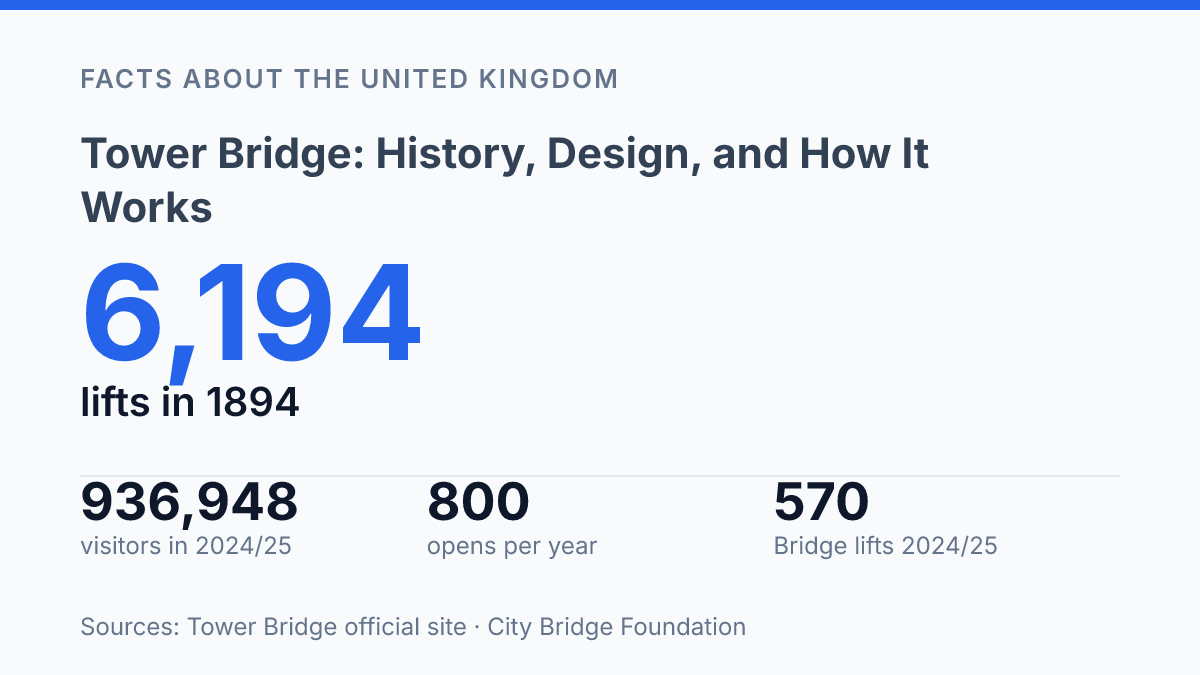
The bridge still opened 570 bridge lifts in 2024/25, proof that its moving roadway isn’t heritage theatre but working infrastructure, according to the bridge owner’s 2025 annual reporting.
Its bascule system is simple in principle. The central roadway splits into two leaves, and each half pivots upward from its tower. A vessel passes through the gap, then the leaves lower back into place for road traffic.
The word “bascule” comes from the idea of a balance. That matters. Counterweights help the huge leaves move with less force than their size suggests.
Victorian machinery did the hard work with hydraulic power. Steam engines drove pumps, the pumps stored pressure. That pressure moved the lifting mechanism when a river passage was needed. Today the operation is electric.
The purpose hasn’t changed. The technology became cleaner and easier to control. The basic bargain stayed the same.
That bargain always involved interruption. Road traffic has to stop so river traffic can move.
The bridge’s fame can hide that blunt fact. It looks ceremonial, but its real job is practical. In my humble opinion, the lifting spans are the part that prove the bridge was a machine first and a landmark second.
Modern openings still serve real vessels, not just postcard moments. Tall ships, cruise vessels, and ceremonial river traffic can pass through when their height demands it.
The official bridge site says vessels with a mast or superstructure of 30 feet, or 9 metres, may request a lift at least 24 hours ahead. That rule turns a dramatic opening into a scheduled piece of city logistics.
For traffic heading through the Pool of London, the bascules made the crossing useful rather than merely handsome. A fixed low bridge would have solved one problem and created another. This one paused the road instead of blocking the river… a compromise with moving parts.
What Tower Bridge means today
The best proof that this bridge isn’t a museum piece is that a repair job can require access from a medieval moat. In 2024/25, the north approach brickwork refurbishment had to be carried out from the moat of the Tower of London, within the Tower’s Scheduled Monument and Grade I context, according to the City Bridge Foundation.
Tower Bridge is Grade I listed, so its protection reflects national importance rather than local affection alone. Seen from the Thames or from the riverside near the fortress, it works as a visual shorthand for London.
That fame can flatten it into a logo. The legal protection reminds you that the fabric itself matters.
Visitor numbers tell only part of the story. The paid attraction welcomed 936,948 people in the year to 31 March 2025, a huge audience by any heritage measure.
Yet people don’t just come to look through glass floors and take photos. They also move across it, queue near it, navigate around it, and plan river journeys through it.
A lot of famous bridges become static monuments; Tower Bridge hasn’t. That’s the difference between a landmark people photograph and a crossing people still depend on. In my view, that practical life is what keeps it from becoming architectural scenery.
This is the tension that makes the bridge matter today. London has to protect it as heritage, sell it as an attraction, and run it as infrastructure at the same time. Those aims don’t always sit neatly together. Tourists want the perfect view.
Road users want movement. River users need access. The bridge still has to answer all three.
The work hidden behind the famous view
The next pressure on Tower Bridge won’t be whether people admire it. They already do.
The harder question is how London keeps a working machine, a protected heritage site. A high-risk public space in balance.
That balance is getting more visible. In 2025, the City Bridge Foundation reported maintenance shaped by the Tower of London’s protected setting, not just engineering need.
Its security reporting also logged 310 CCTV-related incidents in one year. Beauty brings crowds, but crowds bring duty.
In my humble opinion, the bridge matters most when you stop treating it as scenery. It’s a piece of infrastructure still earning its place, one lift, crossing, repair, and difficult decision at a time.
Frequently Asked Questions
Q: When was Tower Bridge built?
A: It was built between 1886 and 1894. That places it right in the late Victorian period, when London wanted a bridge that could handle traffic without blocking river access. The timeline matters because the design had to solve two jobs at once.
Q: Who designed Tower Bridge?
A: Horace Jones designed it, and John Wolfe Barry engineered it with help from Henry Marc Brunel. That mix matters because the bridge had to look dignified and work hard… most bridges only have to do one of those things.
Q: What type of bridge is Tower Bridge?
A: It’s a Grade I listed combined bascule and suspension bridge in London. Until 1960, it also included a cantilever element. The structure has changed over time without losing its identity. In my view, that layered engineering is exactly why it stands out from the crowd.
Q: How does Tower Bridge open for ships?
A: The bridge uses bascules that lift to let river traffic pass. That’s the practical trick at the heart of it. You get road access most of the time. The bridge still opens when the Thames needs it.
Q: Is Tower Bridge the same as London Bridge?
A: No, people mix them up all the time, but they’re different bridges with different jobs and histories. Tower Bridge is the one with the towers and the lifting roadway; London Bridge is a separate crossing nearby. The confusion is common. The distinction is simple once you know what to look for.