
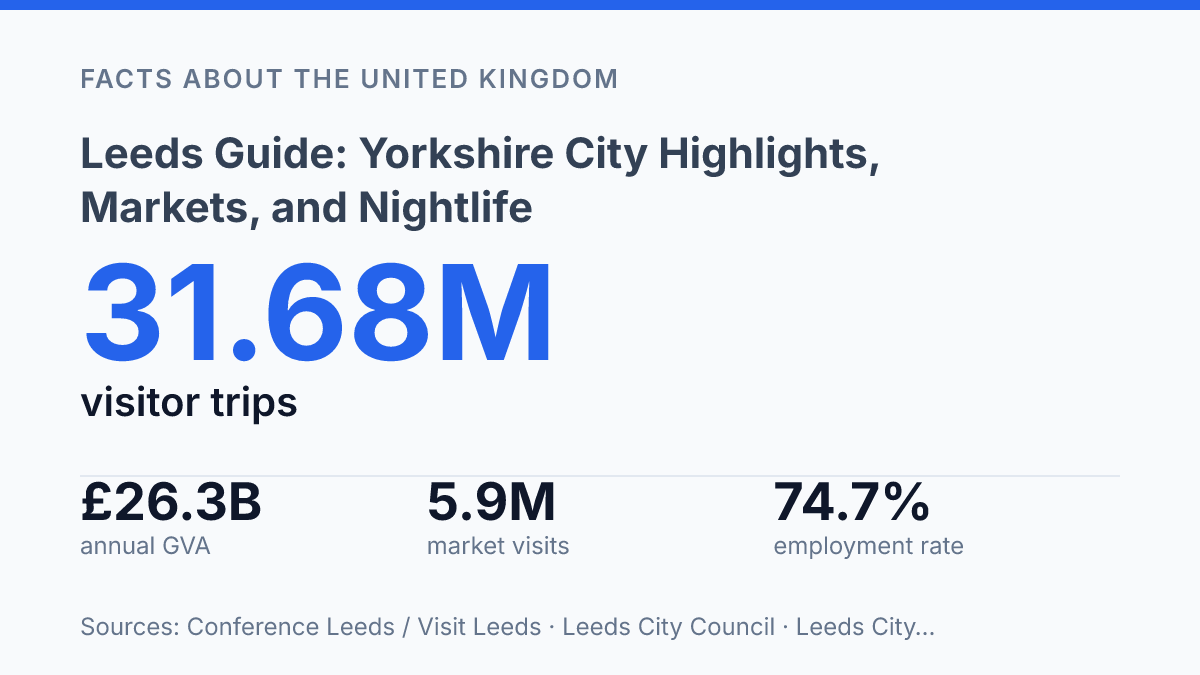
Leeds pulled in 31.68 million visitors in 2023. The best way to read the city isn’t through crowd numbers. It’s through the tension between money, memory, markets, and noise.
This is a city of 812,000 people with a £26.3 billion economy, but its appeal doesn’t sit in one neat district. The national scale of the Royal Armouries sits close to riverside regeneration.
Kirkgate’s food stalls still do real daily trade, even as visitor numbers climb. After dark, Call Lane can feel like the city has changed gear entirely.
That contrast is the point. In my honest opinion, the city works best when you don’t treat it as a polite heritage stop, but as Yorkshire’s working engine with culture, appetite, and late-night pressure all visible at street level.
Why Leeds sits at the heart of Yorkshire
Few English cities let old mills dictate your walking route as firmly as this one does. This is Yorkshire at metropolitan scale: the city sits in West Yorkshire and ranks among England’s largest urban centres. The scale backs that up: Leeds City Council calls it “the economic heart of Yorkshire,” with a population of 812,000, a 74.7% employment rate in December 2023, and £26.3 billion in annual GVA.
The River Aire gives the centre its clearest line of orientation. It cuts through the city rather than sitting politely at the edge, so “north of the river” and “south bank” aren’t throwaway directions. They shape how you read the place on foot.
South of the water, the city changes tone fast. Warehouses, railway arches, service yards, and converted industrial plots sit close to newer flats, cultural spaces, bars, and waterside routes. That mix can feel abrupt, but it’s exactly why the south bank works as a reference point for visitors.
In my view, Leeds looks modern on the surface, but its old industrial plan still controls where the best sights sit. The centre isn’t arranged like a neat tourist grid. It feels more like a working city that has kept adding layers without fully sanding down the old ones.
That matters when you move around. The main shopping streets, market area, riverside museums, and evening streets don’t sit in separate worlds. They connect through short walks, level changes, bridges, and former commercial corridors.
You don’t need to study transport routes for hours. You just need to understand the river and the old industrial core, then the city starts to make practical sense.
The Royal Armouries and the city’s museum draw
A museum built around weapons sounds narrow until you realise it holds around 70,000 arms, armour and artillery objects. That scale changes the visit. The Royal Armouries sits on the south bank of the River Aire, close enough to the centre for an easy walk, but large enough to feel like a destination in its own right.
Its pull comes from status as much as spectacle. This is the national collection of arms and artillery, not a local cabinet of curios. According to the Royal Armouries, the collection also includes nearly 500,000 archive documents, photographs, films and videos, with the main holdings based at the city museum.
The subject matter can sound niche. The galleries work because they treat weapons as evidence of power, design, conflict and ceremony.
Families get the visual impact first. History-minded visitors get the deeper thread behind it. In my honest opinion, that’s why the museum earns its place on a short city itinerary rather than feeling like a specialist detour.
There’s a useful counterpoint here. A collection this big could overwhelm visitors, and not everyone wants a long lesson in military history. The better approach is selective: choose the galleries that match your interest, then leave room for the live displays, temporary shows or riverside stop afterwards.
The museum is still being actively refreshed, too. In 2024/25, a £1.3 million conversion of the 4th and 5th floors was under way for a new Special Exhibitions Gallery, due for completion in 2025/26, according to the Royal Armouries and DCMS annual report. The same report recorded 2,274,640 visits across Royal Armouries sites and a 91.9% visitor recommendation rate, which says plenty about its broad appeal.
Kirkgate Market and the food-shopping scene
5.9 million visits in 2024 is the clearest sign that this is not a heritage exhibit pretending to trade. The council’s 2025 market update said visits rose 4% on the previous year and 33% since 2021, a jump that points to regular use rather than one-off curiosity.
Kirkgate Market earns that traffic through scale and variety. Leeds Kirkgate Market combines indoor halls with outdoor stalls.
The mood changes as you move from butchers, fishmongers, bakers, and fruit stalls to street-food counters and small specialist traders. It feels layered, not curated.
Museums & Galleries described Kirkgate in 2025 as Europe’s largest covered market, with around 800 stalls across covered and open-air areas. That size can work against a place if it turns into clutter, but here it gives shoppers options. You can buy ingredients for dinner, grab lunch, browse household goods, and still find traders who know their customers by name.
Food is the real pull. Fresh produce anchors the market, then independent cafés, takeaway counters, spice sellers, sweet stalls, and regional suppliers fill in the gaps.
The draw isn’t just what’s cheap. It’s the range: practical shopping beside quick meals, everyday errands beside something you didn’t plan to buy.
A market can sound old-fashioned, but Kirkgate works because it is still useful…In my humble opinion, that makes it more convincing than polished shopping streets. The 2025 update also recorded more than 250 events and 20 new indoor businesses. The place isn’t surviving on nostalgia.
It’s adapting. It hasn’t lost the point of a market: people come in, compare, chat, eat, and leave with full bags.
Call Lane after dark: bars, music, and converted arches
The signature sound of Call Lane isn’t a DJ drop. It’s music leaking from brick arches that still carry the weight of the railway above.
That detail matters. This corner of the city doesn’t feel designed by a leisure consultant, and that’s a large part of its pull.
The area sits across the river from the main civic core. The mood shifts as you move into it. Offices, yards, warehouses, and railway infrastructure gave the place a harder frame before redevelopment turned it into a compact night-time strip. In my view, that scraped-back quality is exactly why it works.
Regeneration here didn’t wipe the old fabric clean. It put bars, late rooms, and small live music spaces into it. The converted arches give the area a low-ceilinged, close-range feel, with sound bouncing off brick rather than polished glass.
Council figures show why the area no longer feels peripheral. In 2023/24, 1,580 city-centre homes were completed, with 29% south of the river. That shift matters at night, since more residents, hotels, offices, and venues now sit around streets that once felt more separate from the main centre.
Still, this is not a glossy entertainment quarter. The setting is rougher than a packaged bar zone.
That edge creates both character and pressure. It feels worked-for, not manufactured… but you notice the seams.
The same tension shows up in licensing data. The central city MSOA ranks 1st out of 107 local areas for overall alcohol-licensing risk. Streets including Call Lane see crime rise after 23:00, then peak between 00:00 and 03:00, according to the council’s licensing policy.
That doesn’t make the area off-limits. It does mean the best way to read it is honestly: lively, compact, late, and uneven. Its reputation comes from that mix of railway-arch gigs, close-packed bars, and post-industrial grit rather than from a single flagship venue or a neat tourist pitch.
Why timing changes the whole city
Treat Leeds as a timed city, not a checklist. Go early where the day still belongs to traders and museums. Then decide how much of the night you actually want.
The same centre that reports a 74.7% employment rate also has streets where risk rises after 23:00. That doesn’t ruin Call Lane. It makes timing, route choice, and awareness part of the experience.
By 2025/26, new gallery space at the armouries will add another reason to stay longer. More visitors will follow. In my humble opinion, the smartest travellers won’t chase every stop. They’ll notice how the city changes hour by hour… and move with it.
Frequently Asked Questions
Q: What is Leeds best known for?
A: Leeds is known for its mix of culture, shopping, and nightlife. The city also has a strong industrial past. That history now sits beside modern bars, markets, and museums. In my view, that’s exactly why it feels sharper and more interesting than a polished city break.
Q: Is Leeds good for a weekend trip?
A: Yes, it works well for a short break. You can cover the Royal Armouries, Kirkgate Market. The Call Lane nightlife area without wasting much time getting around. The trick is balance… do the market and museums by day, then save the arches and bars for later.
Q: Where should I go for nightlife in Leeds?
A: Call Lane is one of the main places to start. The redeveloped area across the River Aire has bars and live music venues under converted railway arches. It has character as well as energy. That mix matters. You get a setting that feels less generic than a standard club strip.
Q: Is Leeds Kirkgate Market worth visiting?
A: Yes, especially if you like places that feel busy without trying too hard. Leeds Kirkgate Market has hundreds of indoor and outdoor stalls. You can browse food, local goods, and everyday finds in one stop. The scale is the draw. The real appeal is how much there is to look at before you even buy anything.
Q: What can you see near the River Aire in Leeds?
A: The south bank is home to the Royal Armouries, which holds the national collection of arms and artillery. Across the river, you’ve got Call Lane with its bars and live music spots. The area gives you culture on one side and late-night energy on the other. That contrast is the point.